
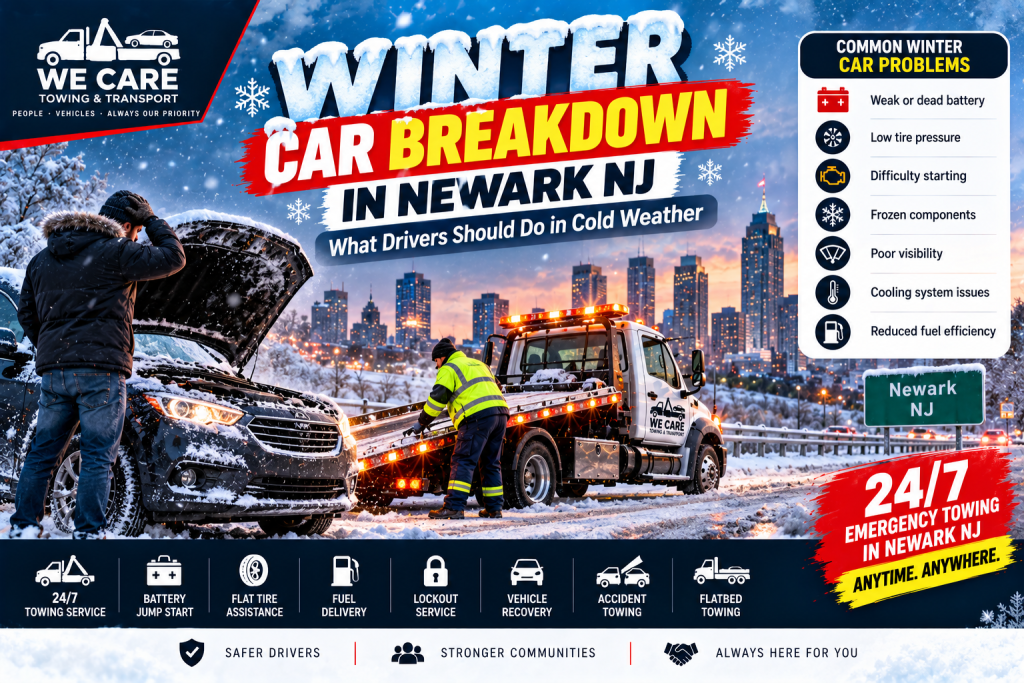
Winter driving in Newark, NJ, can bring unexpected challenges for drivers. Cold temperatures, icy roads, and snow can make everyday travel more difficult. A vehicle that works perfectly during warmer months may experience battery problems, tire pressure changes, or other mechanical issues when the temperature drops.
A winter car breakdown in Newark NJ can happen while commuting to work, traveling through the city, or driving on a highway. Knowing what to do when your vehicle stops working can help you stay safer and make it easier to arrange professional assistance.
In this guide, we explain common cold-weather vehicle problems, what to do if your car breaks down, and when to consider calling a professional towing service.
Why Do Cars Break Down During Winter?
Cold weather can affect several vehicle components. Some problems may become more noticeable when temperatures drop.
Common winter vehicle problems include:
- Weak or discharged batteries
- Low tire pressure
- Difficulty starting the engine
- Frozen or damaged components
- Poor visibility caused by snow or ice
- Cooling system problems
- Reduced electric vehicle driving range
Not every winter breakdown has the same cause. If your vehicle develops a serious mechanical problem, a qualified mechanic may need to inspect it.
1. Battery Problems in Cold Weather
A weak battery may have difficulty starting an engine during cold weather. If your vehicle takes longer than usual to start, makes clicking sounds, or does not start at all, the battery or starting system may need attention.
Before winter, consider having your battery and charging system inspected.
If your car will not start during a cold morning in Newark, roadside assistance may be able to help with a battery jump start, depending on the problem.
However, a jump start may not resolve the issue if the battery is damaged or another component has failed.
If your vehicle still will not start, professional towing may be necessary.
You can also read our guide about the battery warning light in Newark NJ to learn more about battery and charging system problems.
2. Check Your Tire Pressure Before Driving
Tire pressure can decrease as outside temperatures drop. Driving with incorrectly inflated tires can affect vehicle handling and tire performance.
Before driving during winter, check your tire pressure when the tires are cold. Follow the recommended pressure listed in your vehicle owner’s manual or on the driver’s side door label.
Also check for:
- Visible tire damage
- Uneven tire wear
- Low tread depth
- Cracks or bulges
- A properly inflated spare tire, if equipped
If a tire becomes damaged while driving, slow down carefully and move to a safe location if possible.
If the vehicle cannot be driven safely, consider arranging roadside assistance or towing.
3. What to Do If Your Car Breaks Down in Winter
If your vehicle breaks down during cold weather, your safety should be the first priority.
Follow these general steps:
Move to a Safe Location
If the vehicle is still moving and road conditions allow, carefully move away from traffic.
Avoid sudden steering or braking, especially on slippery roads.
If you cannot move the vehicle safely, turn on your hazard lights and assess your surroundings.
Turn On Your Hazard Lights
Hazard lights help make your disabled vehicle more visible to other drivers.
This is particularly important during snow, fog, darkness, or poor visibility.
Stay Warm and Be Aware of Your Surroundings
If you are stopped in a safe location, remain aware of the weather and your surroundings while waiting for assistance.
If you need to run the engine for warmth, make sure the exhaust pipe is clear of snow and never run the engine for extended periods in an enclosed space. Carbon monoxide can be dangerous.
Follow local emergency guidance if conditions become unsafe.
Contact Roadside Assistance
Once you are in a safe position, arrange appropriate roadside assistance.
Provide your exact location, vehicle make and model, and a description of the problem.
If your vehicle cannot be repaired at the roadside or is unsafe to drive, a towing service may be needed.
For additional winter safety information, read the NHTSA Winter Driving Tips.
4. Keep a Winter Emergency Kit in Your Car
Preparing an emergency kit before winter can help you handle unexpected delays or breakdowns.
Consider keeping these items in your vehicle:
- Warm blankets
- Flashlight with spare batteries
- Phone charger or power bank
- Ice scraper and snow brush
- Jumper cables
- Reflective warning devices
- Drinking water
- Non-perishable snacks
- First-aid kit
- Gloves and warm clothing
- Small snow shovel
Keep emergency supplies somewhere accessible.
If you become stranded, use your supplies while waiting for help, and avoid placing yourself in danger to retrieve items.
5. Driving on Snowy or Icy Roads
Snow and ice can make it harder to control and stop your vehicle.
When driving in winter conditions:
- Reduce your speed when road conditions require it.
- Leave additional space between your vehicle and the one ahead.
- Avoid sudden acceleration and braking.
- Check weather and road conditions before traveling.
- Make sure your headlights and windshield wipers work properly.
- Avoid unnecessary travel during severe weather.
If the roads are unsafe, consider delaying your trip until conditions improve.
6. When Should You Call a Tow Truck During Winter?
Some winter vehicle problems can be resolved with roadside assistance. Others may require professional towing.
Consider calling a tow truck if:
- Your vehicle will not start and roadside assistance cannot resolve the issue.
- Your car has a serious mechanical problem.
- Your tires or wheels are damaged.
- Your vehicle is stuck in a location where it cannot safely move.
- Your vehicle has been involved in an accident.
- Warning lights indicate a serious problem.
- You cannot safely continue driving.
- Your vehicle is stranded in a dangerous location.
If you are unsure whether your vehicle is safe to drive, stop in a safe location and seek professional assistance.
Our car towing service in Newark NJ can help when a vehicle needs professional transportation.
7. Why Flatbed Towing May Be Useful in Winter
Flatbed towing transports a vehicle on a platform, keeping its wheels off the road during transportation.
Depending on the vehicle and its condition, flatbed towing may be suitable for:
- Vehicles with serious mechanical problems
- Cars with damaged wheels
- AWD and 4WD vehicles that require a specific towing method
- Vehicles involved in accidents
- Cars that cannot be driven safely
The correct towing method depends on the vehicle manufacturer’s instructions and the condition of the vehicle.
Learn more about our flatbed towing service in Newark NJ.
8. What to Tell the Towing Company
When requesting towing during winter, provide clear information so the operator can understand your situation.
Be ready to share:
- Your exact location
- Vehicle make, model, and year
- Whether the vehicle starts
- Whether the vehicle can move
- Any visible damage
- Whether the vehicle is stuck in snow
- Your preferred destination
If you are on a highway, provide the highway name, direction of travel, nearest exit, or mile marker if available.
For example, if your vehicle breaks down on I-78, this information can help the towing provider identify your location.
You can learn more about I-78 highway towing in Newark NJ.
9. How to Prepare Your Vehicle Before Winter
A few basic maintenance steps may help you reduce the likelihood of certain winter vehicle problems.
Before winter arrives:
- Have your battery and charging system checked.
- Inspect your tires and tire pressure.
- Check your windshield wipers and washer fluid.
- Make sure your headlights and hazard lights work.
- Check coolant levels according to your owner’s manual.
- Keep your fuel tank adequately filled.
- Review your vehicle manufacturer’s winter driving recommendations.
If you notice unusual sounds, warning lights, or changes in vehicle performance, arrange an inspection rather than ignoring the problem.
24/7 Winter Towing Service in Newark NJ
Vehicle breakdowns can happen at any time, including during cold mornings, late-night commutes, and winter storms.
We Care Towing & Transport provides 24/7 towing and roadside assistance in Newark, NJ, and surrounding areas.
Our services include:
- Emergency towing
- Flatbed towing
- Vehicle recovery
- Accident towing
- Battery jump starts
- Flat tire assistance
- Fuel delivery
- Vehicle lockout assistance
- Vehicle transportation
If your vehicle cannot safely continue, professional towing can help transport it to an appropriate destination.
Visit our 24/7 towing service in Newark NJ page to learn more.
Final Thoughts
Winter vehicle problems can happen unexpectedly, but preparation can help drivers respond more safely.
Check your vehicle before winter, keep emergency supplies in your car, and pay attention to warning signs while driving.
If your vehicle breaks down, move to a safe location when possible, turn on your hazard lights, and arrange appropriate assistance.
When a vehicle cannot be driven safely, professional towing may be the right way to transport it.
We Care Towing & Transport provides 24/7 towing and roadside assistance in Newark, NJ, and surrounding areas.