When a vehicle needs to be towed, getting it onto the tow truck is only one part of the process. Proper positioning and securing are also important steps before transportation begins.
A car may need towing because it has broken down, has been damaged in an accident, will not start, or cannot safely be driven. In each situation, the vehicle needs to be handled according to its condition.
For drivers looking for vehicle securing during towing in Newark NJ, understanding why proper loading and securing matter can help you better understand the towing process.
What Does Vehicle Securing During Towing Mean?
Vehicle securing refers to preparing and securing a vehicle so it can remain properly positioned during transportation.
When a vehicle is placed on a tow truck or other towing equipment, the towing professional needs to consider the vehicle’s position and condition before transportation.
The process can involve:
- Positioning the vehicle correctly
- Checking the vehicle’s condition
- Using appropriate securing equipment
- Making sure the vehicle remains stable
- Considering damaged or non-running vehicles
- Checking the vehicle before transportation
The exact procedure can vary depending on the type of tow truck, vehicle, and towing situation.
Why Is Proper Vehicle Securing Important?
A vehicle is transported differently from a vehicle being driven normally.
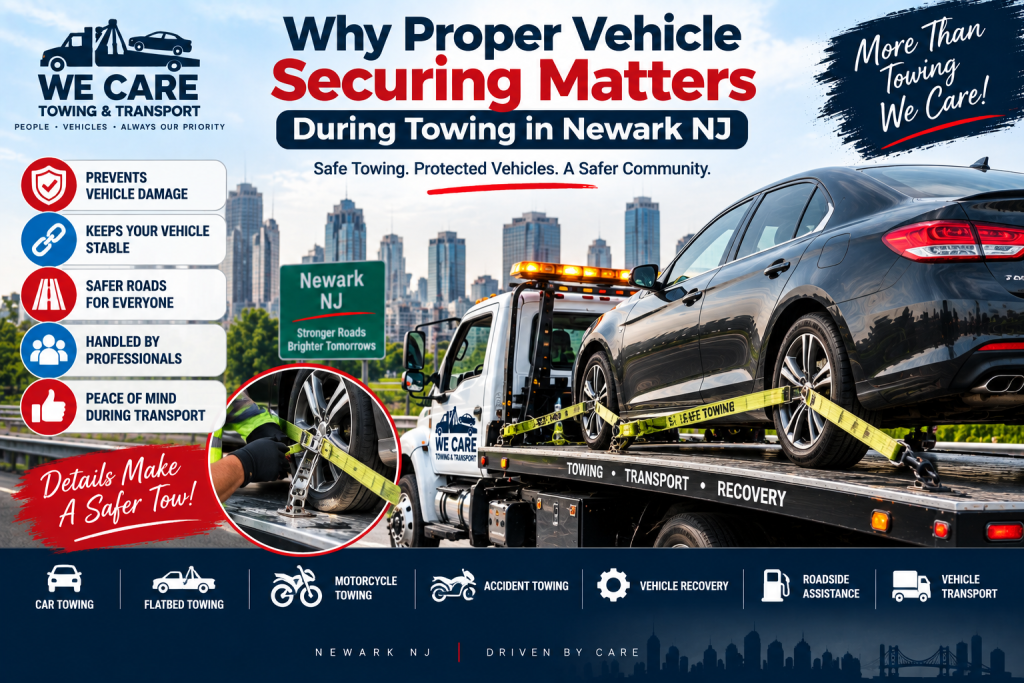
During transportation, the tow truck can accelerate, brake, turn, and travel over different road surfaces. Properly securing the vehicle helps keep it positioned appropriately throughout the journey.
Proper securing is particularly important when transporting:
- Damaged vehicles
- Non-running vehicles
- Accident-damaged vehicles
- Vehicles requiring recovery
- Vehicles being transported to a repair facility
The vehicle’s condition should always be considered before transportation begins.
How Are Vehicles Prepared for Towing?
The preparation process depends on the vehicle and the towing situation.
Vehicle Condition Is Checked
Before transportation, the towing professional needs to understand the vehicle’s condition.
Important considerations may include:
- Whether the vehicle starts
- Whether the wheels can move
- Whether the steering works
- Whether the vehicle has accident damage
- Whether the tires are damaged
- Whether the vehicle can be moved normally
A vehicle that is running normally may be easier to position than a completely non-running or damaged vehicle.
Vehicle Positioning
Proper positioning helps ensure the vehicle is placed appropriately on the towing equipment.
The towing professional considers the vehicle’s position and the available towing equipment before transportation.
Securing the Vehicle
Appropriate securing equipment is used to help keep the vehicle positioned during transportation.
The specific equipment and procedure depend on the vehicle and towing method.
Why Non-Running Vehicles May Require Extra Attention
A non-running vehicle cannot simply be driven onto a tow truck.
The towing professional may need to consider how the vehicle can be moved and positioned safely.
Before arranging a tow for a non-running vehicle, provide information about:
- Whether the wheels roll
- Whether the steering works
- Whether the vehicle can be moved
- Where the vehicle is located
- Whether there is visible damage
- Whether the vehicle is accessible
This information can help the towing provider understand the situation before arriving.
Towing Accident-Damaged Vehicles
Accident-damaged vehicles can present additional transportation challenges.
A collision may affect tires, wheels, steering components, body panels, or other parts of the vehicle.
Because of this, an accident-damaged vehicle may need to be handled differently from a normal local tow.
When requesting accident towing, explain the vehicle’s condition as accurately as possible.
If there is significant damage or the vehicle cannot move normally, tell the towing provider before transportation begins.
Flatbed Towing and Vehicle Securing
Flatbed towing is one option for transporting certain vehicles.
With a flatbed tow truck, the vehicle is transported on a flat platform rather than being driven to the destination.
Flatbed towing may be useful for:
- Non-running vehicles
- Accident-damaged vehicles
- Certain mechanical breakdowns
- Vehicles that should not be driven
- Vehicle transportation needs
Proper positioning and securing remain important regardless of the vehicle’s condition.
What Can Drivers Do Before the Tow Truck Arrives?
Drivers can provide useful information before the towing professional arrives.
Tell the Towing Company About the Vehicle
Explain whether the vehicle:
- Starts
- Moves
- Has damaged wheels
- Has a flat tire
- Has accident damage
- Is parked in a difficult location
Provide the Correct Location
Give the towing company an accurate location and useful landmarks if available.
This is especially helpful when the vehicle is stopped near a large roadway, parking area, intersection, or other difficult-to-identify location.
Do Not Attempt Unsafe Repairs
If the vehicle is in an unsafe location or has significant damage, avoid attempting repairs in an area where traffic creates a risk.
Your safety should remain the first priority.
How Proper Securing Helps During Vehicle Transport
A vehicle may travel through different road conditions while being transported.
Proper securing helps maintain the vehicle’s intended position during transportation.
This is particularly relevant for vehicles that are:
- Not running
- Damaged
- Being recovered
- Being transported over a longer distance
- Being taken to a repair facility
Professional towing involves more than simply moving a vehicle from one location to another.
Vehicle Recovery and Proper Handling
Some towing situations involve vehicle recovery rather than a standard roadside tow.
A vehicle may require recovery when it cannot be easily moved from its current position.
Examples may include vehicles involved in accidents or vehicles that have become disabled in difficult locations.
Before recovery begins, the towing professional needs to assess the situation and determine how the vehicle can be moved.
Once recovered, the vehicle may need to be transported to a repair facility or another destination.
What Information Should You Provide for a Towing Request?
When requesting car towing in Newark NJ, provide as much accurate information as possible.
Useful information includes:
- Vehicle make and model
- Current location
- Vehicle condition
- Whether the vehicle starts
- Whether the vehicle moves
- Whether the vehicle has accident damage
- Whether the tires or wheels are damaged
- Your destination
Providing this information helps the towing provider understand what type of assistance may be appropriate.
Does Every Vehicle Need the Same Towing Method?
No.
The appropriate towing method can depend on:
- Vehicle type
- Vehicle size
- Vehicle condition
- Whether the vehicle runs
- Type of damage
- Location of the vehicle
- Transportation destination
For example, a normally functioning vehicle may require a different towing approach from an accident-damaged or non-running vehicle.
If you are unsure what type of towing your vehicle requires, describe the situation to the towing professional.
What Happens After the Vehicle Is Secured?
Once the vehicle has been appropriately positioned and secured, transportation can begin.
The vehicle may be taken to:
- An auto repair shop
- A dealership
- A private property
- Another requested destination
- A location where additional inspection or repairs can take place
The destination should be clearly communicated when the towing service is arranged.
Why Professional Towing Can Be Useful
Attempting to move a disabled or damaged vehicle without appropriate equipment can create additional difficulties.
Professional towing services have equipment designed for vehicle transportation and recovery.
A professional towing provider can assess the vehicle and determine an appropriate transportation method based on its condition.
This can be especially useful when dealing with:
- Non-running vehicles
- Accident-damaged vehicles
- Vehicles with damaged wheels or tires
- Difficult recovery situations
- Vehicles that cannot safely be driven
Vehicle Securing During Towing in Newark NJ
For drivers in Newark, NJ, vehicle problems can happen unexpectedly.
A vehicle may become disabled while commuting, traveling through the city, or heading to a repair facility.
When towing is necessary, proper vehicle handling, positioning, and securing are important parts of the transportation process.
We Care Towing & Transport provides towing, vehicle recovery, vehicle transportation, and roadside assistance services for customers in Newark, NJ and surrounding areas.
Towing Services Available
We Care Towing & Transport provides services including:
- Car towing
- Local towing
- Emergency towing
- Flatbed towing
- Accident towing
- Vehicle recovery
- Vehicle transport
- Damaged vehicle transport
- Non-running vehicle transport
- Motorcycle towing
- Roadside assistance
- Battery jump starts
- Flat tire assistance
- Fuel delivery
- Vehicle lockout service
- Junk car removal
Each towing situation can be different, so providing accurate information about your vehicle helps determine what type of assistance may be appropriate.
Why Choose We Care Towing & Transport?
We Care Towing & Transport provides professional towing, vehicle transport, and roadside assistance services for customers in Newark, NJ and surrounding areas.
Our services support drivers dealing with disabled, damaged, or non-running vehicles as well as customers who need vehicle transportation.
If your vehicle needs towing, recovery, or transportation, contact We Care Towing & Transport and provide information about your vehicle’s condition and location.
Contact We Care Towing & Transport
Business Name: We Care Towing & Transport
Address: 68 A Crane St, Newark, NJ 07104, United States
Phone: 973-336-1721
Email: wecaretransportnj@gmail.com
Website: https://wecaretransportnj.com/
If your vehicle is damaged, disabled, or cannot safely be driven, proper towing and vehicle transportation can help move it to the appropriate destination.
For vehicle securing during towing in Newark NJ, contact We Care Towing & Transport for professional towing, vehicle recovery, transportation, and roadside assistance.
Choose professional towing when your vehicle needs safe transportation in Newark, NJ and surrounding areas.