
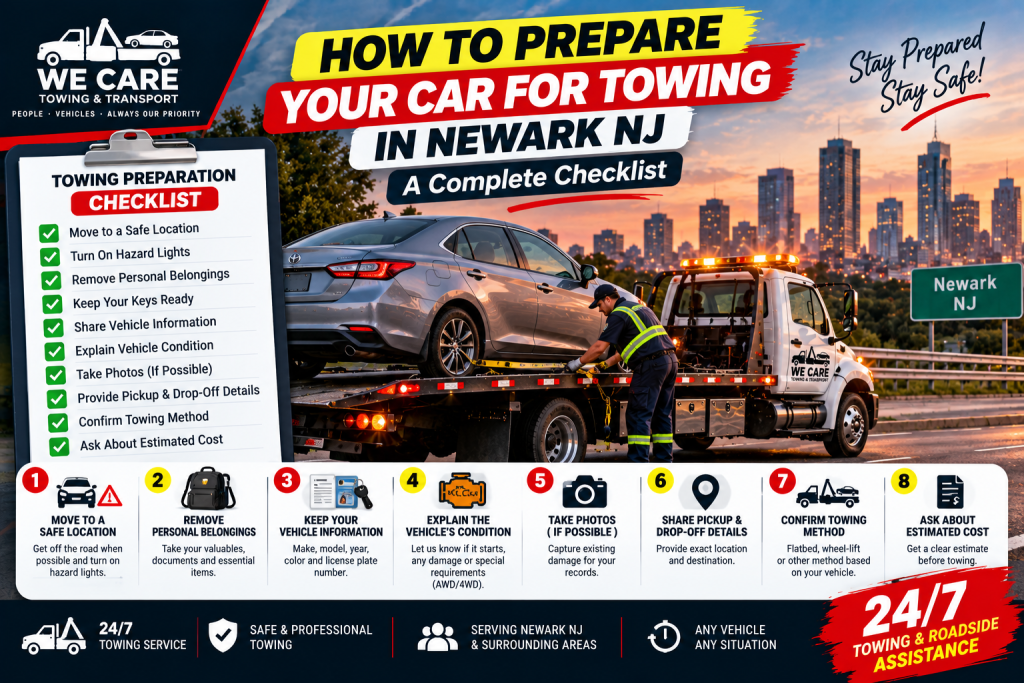
When your vehicle breaks down or needs to be transported, knowing how to prepare your car for towing in Newark NJ can make the process easier. Whether your car has mechanical problems, has been involved in an accident, or simply needs transportation to a repair shop, a few simple steps can help you prepare.
Before a tow truck arrives, it is useful to understand what information to provide, which belongings to remove, and how to make the pickup location accessible. Proper preparation can also help the towing operator understand your vehicle’s condition and determine what equipment may be needed.
In this guide, we explain how to prepare your vehicle for towing and what to consider before your tow truck arrives.
1. Move Your Vehicle to a Safe Location If Possible
Your safety should be the first priority when your vehicle needs towing.
If your car is still moving and it is safe to do so, move it away from traffic. A nearby parking lot, driveway, or other safe location may make the towing process easier.
If your vehicle breaks down on a busy road or highway, avoid attempting to move it if doing so would put you in danger.
Turn on your hazard lights to make your vehicle more visible to other drivers. If you are on a highway and feel unsafe, contact the appropriate emergency services.
New Jersey’s Department of Transportation operates a Safety Service Patrol on certain highways to assist motorists with disabled vehicles. You can learn more about the NJDOT Safety Service Patrol.
2. Remove Your Personal Belongings
Before your vehicle is loaded onto a tow truck, remove personal belongings that you may need.
Check areas such as:
- Glove compartment
- Center console
- Door pockets
- Trunk
- Back seats
- Under the seats
- Cup holders
Remember to remove important items such as wallets, documents, sunglasses, electronic devices, and house keys.
If your vehicle is being transported to a repair shop, consider removing valuables and any items you will need while the vehicle is being inspected.
Do not put yourself at risk trying to retrieve belongings from a vehicle that is in an unsafe location.
3. Collect Your Vehicle Information
When requesting towing service, the operator may need information about your vehicle.
Try to have the following details ready:
- Vehicle make
- Vehicle model
- Vehicle year
- Vehicle color
- License plate number
- Vehicle location
- Destination for the tow
You should also explain whether the vehicle starts, whether it can move, and whether it has any visible damage.
For example, tell the towing provider if your car has a damaged tire, locked steering wheel, mechanical failure, or accident damage.
This information can help the operator understand your situation and prepare suitable towing equipment.
4. Explain the Vehicle’s Condition Clearly
Not every vehicle can be loaded in the same way.
Before the tow truck arrives, explain any known problems with your vehicle.
For example:
- The engine will not start.
- The transmission is not working.
- The steering wheel is locked.
- One or more wheels are damaged.
- The vehicle has been involved in an accident.
- The car is stuck in a parking space.
- The vehicle has low ground clearance.
- The vehicle is AWD or 4WD.
Some vehicles require special loading procedures or equipment. For example, certain AWD vehicles may require flatbed towing according to the manufacturer’s instructions.
If you are unsure about your vehicle’s requirements, tell the towing provider what you know and ask about the appropriate towing method.
5. Choose an Appropriate Towing Method
The towing method depends on your vehicle and its condition.
A flatbed tow truck carries the vehicle on a platform, keeping all four wheels off the road during transportation. It may be suitable for vehicles with certain drivetrain requirements, accident damage, or mechanical problems.
Wheel-lift towing may be appropriate for some vehicles, depending on the vehicle manufacturer’s instructions and its condition.
Before towing, tell the provider if your vehicle has special requirements.
You can learn more about our flatbed towing service in Newark NJ to understand how this type of towing works.
6. Take Photos of Your Vehicle Before Towing
Taking photographs before your vehicle is loaded can help you keep a record of its condition.
If it is safe to do so, take clear photos of:
- Front of the vehicle
- Rear of the vehicle
- Both sides
- Existing scratches or dents
- Damaged wheels or tires
- Visible accident damage
These photos can serve as a personal record of the vehicle’s condition before transportation.
If the vehicle is in a dangerous location, do not walk around it to take pictures. Your safety is more important.
7. Check the Pickup and Drop-Off Locations
Before the tow truck arrives, confirm the pickup location and destination.
Provide clear directions if your vehicle is parked in a large parking lot, apartment complex, garage, or a location with restricted access.
Tell the towing provider about any possible obstacles, such as:
- Narrow entrances
- Low parking garage ceilings
- Tight turns
- Restricted access gates
- Limited parking space
- Underground parking
This information may help the provider determine which truck and equipment are suitable for the pickup.
Also, confirm that the destination can receive the vehicle. If you are taking it to a repair shop, check whether the shop can accept the vehicle at the expected arrival time.
8. Keep Your Vehicle Keys Ready
If you have your vehicle keys, keep them available for the towing operator.
Depending on the vehicle and its condition, the operator may need the keys to access the vehicle or follow the manufacturer’s loading procedure.
If you have lost your keys or the steering wheel is locked, tell the towing provider before the truck arrives.
Do not force the steering wheel or attempt to move a vehicle that is not safe to operate.
9. Understand What to Do If Your Car Breaks Down on a Highway
A breakdown on a highway requires additional care because of moving traffic.
If your vehicle becomes disabled on I-78 or another highway in Newark, turn on your hazard lights and move to a safe location if possible.
Avoid standing close to moving traffic or attempting repairs in an unsafe area.
New Jersey’s Safety Service Patrol may assist with certain disabled-vehicle situations on covered highways. However, its role is different from private towing, and it does not provide routine towing to a repair shop or home.
For more information about highway towing, visit our guide to I-78 highway towing in Newark NJ.
10. Confirm the Towing Destination and Pricing
Before the vehicle is transported, confirm where it needs to go.
Possible destinations include:
- A repair shop
- A dealership
- Your home
- A secure storage location
- Another location agreed upon with the towing provider
Ask the towing provider about the estimated cost and any additional charges that may apply.
The final price may depend on factors such as distance, vehicle condition, towing method, and the circumstances of the pickup.
Confirming these details beforehand can help avoid misunderstandings.
11. What If Your Vehicle Cannot Be Driven?
Some vehicles cannot be driven because of serious mechanical problems, accident damage, or other issues.
If your car cannot be driven safely, do not attempt to move it simply to make the towing process easier.
Explain the problem to the towing provider. The operator can then determine what equipment and loading procedure may be appropriate.
Our car towing service in Newark NJ is available for vehicles that cannot be driven because of breakdowns or accidents.
Car Towing Preparation Checklist
Before the tow truck arrives, use this simple checklist:
- Move to a safe location if possible.
- Turn on hazard lights when appropriate.
- Remove personal belongings if it is safe.
- Collect your vehicle’s make, model, and year.
- Explain the vehicle’s mechanical condition.
- Mention any damaged or locked wheels.
- Tell the provider if the vehicle is AWD or 4WD.
- Share any access restrictions at the pickup location.
- Confirm the drop-off destination.
- Ask about towing charges.
- Keep the vehicle keys ready if available.
- Take photos of existing damage if it is safe.
You may not need to complete every step in every situation. If your vehicle is in a dangerous location, prioritize your safety and follow emergency instructions.
24/7 Car Towing Service in Newark NJ
Vehicle breakdowns and transportation needs can happen at any time. Being prepared can help make the towing process more organized, whether your vehicle needs emergency assistance or scheduled transportation.
We Care Towing & Transport provides 24/7 towing and roadside assistance in Newark NJ and surrounding areas.
Our services include:
- Emergency towing
- Flatbed towing
- Car towing
- Accident recovery
- Vehicle transportation
- Battery jump starts
- Flat tire assistance
- Fuel delivery
- Vehicle lockout assistance
If your vehicle cannot be driven safely, professional towing can help transport it to an appropriate destination.
Visit our 24/7 towing service in Newark NJ page to learn more about our services.
Final Thoughts
Preparing your car before towing can help make the pickup and transportation process easier. Sharing accurate vehicle information, removing personal belongings, confirming the destination, and explaining any mechanical problems can help the towing provider prepare for your situation.
Always prioritize safety, especially when your vehicle breaks down on a busy road or highway. Avoid attempting repairs or moving the vehicle if the situation is unsafe.
If you need towing in Newark NJ, We Care Towing & Transport provides 24/7 towing and roadside assistance for drivers dealing with unexpected vehicle problems.