
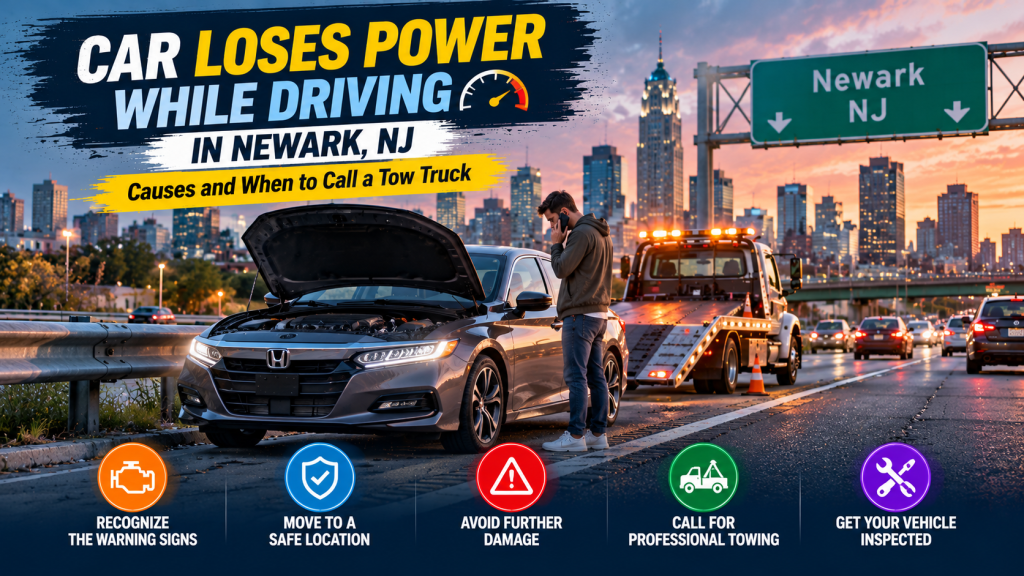
Imagine driving through Newark, New Jersey, when your car suddenly stops accelerating normally. You press the gas pedal, but the vehicle responds slowly, struggles to maintain speed, or begins losing power. This situation can be stressful, especially during rush hour, on busy roads, or while merging onto a highway.
When a car loses power while driving in Newark, NJ, it is important to recognize the warning signs, move to a safe location, and determine whether the vehicle can continue safely. Although some issues may be minor, sudden power loss can also indicate a serious mechanical or electrical problem.
We Care Towing & Transport helps drivers understand when a vehicle may need professional towing rather than continued driving. Here is what you should know if your car suddenly loses power on the road.
What Does It Mean When Your Car Loses Power While Driving?
Power loss occurs when your vehicle cannot accelerate or maintain its normal performance. You might notice that the engine struggles when you press the accelerator, the vehicle slows down unexpectedly, or the engine runs unevenly.
Common warning signs include:
- The car struggles to accelerate.
- The engine suddenly feels weak.
- The vehicle loses speed while going uphill.
- The engine warning light appears.
- The engine sputters or shakes.
- The vehicle enters a reduced-power or limp mode.
- The engine stalls or shuts off unexpectedly.
These symptoms do not always indicate the same problem. The cause may involve the fuel system, ignition components, air intake, electrical system, transmission, or another mechanical component.
If the vehicle loses significant power or becomes difficult to control, do not continue driving simply to reach your destination.
7 Common Reasons a Car Loses Power While Driving
1. Fuel System Problems
Your engine needs a consistent fuel supply to operate properly. If the fuel pump is failing, the fuel filter is restricted, or another fuel delivery component is malfunctioning, the engine may struggle to produce enough power.
You might notice hesitation during acceleration, sputtering, or difficulty maintaining speed. In some cases, the vehicle may stall.
If the engine repeatedly loses power, avoid repeatedly pressing the accelerator to force the car to move. Arrange for a qualified mechanic to inspect the vehicle. If it cannot be driven safely, consider professional towing.
2. Ignition System Problems
Spark plugs and ignition coils help the engine ignite its air-fuel mixture. When these components malfunction, the engine may misfire, run unevenly, or struggle during acceleration.
Possible warning signs include engine vibration, rough idling, hesitation, and an illuminated check engine light.
A flashing check engine light can indicate a serious engine misfire. Reduce driving as safely as possible and stop in a safe location. Continuing to drive with a severe misfire may cause additional damage.
Read our related guide on car towing services in Newark, NJ to learn more about getting help when your vehicle is no longer safe to drive.
3. Air Intake or Sensor Issues
Your vehicle’s engine management system uses sensors to monitor airflow and other operating conditions. Problems with an airflow sensor, throttle position sensor, or related component can affect engine performance.
Symptoms may include sluggish acceleration, inconsistent engine response, or reduced engine power.
These symptoms alone cannot identify the exact faulty part. A mechanic may need to scan the vehicle’s diagnostic codes and perform additional tests before recommending a repair.
If the vehicle enters limp mode and cannot maintain a safe speed, pulling over and arranging a tow is generally safer than trying to continue through busy Newark traffic.
4. Transmission Problems
The transmission transfers engine power to the wheels. When it develops a fault, your vehicle may hesitate, struggle to change gears, slip between gears, or fail to accelerate normally.
You may also notice unusual noises, burning smells, or warning lights.
Transmission problems can worsen when a vehicle continues operating under unsafe conditions. If the car struggles to move, loses drive, or experiences severe shifting problems, stop in a safe place and seek professional assistance.
For more information, read our guide to transmission failure towing in Newark, NJ.
5. Electrical System or Charging Problems
Your car depends on electrical power for many important systems. A failing alternator, damaged wiring, or an electrical connection problem can affect vehicle operation.
Watch for warning signs such as dimming lights, multiple dashboard warning indicators, electrical accessories behaving unusually, or an illuminated battery warning light.
A battery warning light does not necessarily mean that the battery itself is the only problem. It can indicate a charging-system issue that needs inspection.
If electrical problems are accompanied by engine stalling, loss of steering assistance, or other serious symptoms, move away from traffic safely and request professional help.
You can also read our article about the battery light coming on in Newark, NJ.
6. Engine Overheating
An overheating engine can lose performance and may suffer serious damage if you continue driving.
Warning signs can include a temperature gauge entering the red zone, a temperature warning light, steam from under the hood, or an unusual hot smell.
If your engine overheats, pull over safely and turn it off. Do not open a hot radiator cap or attempt to handle hot cooling-system components. Allow the vehicle to cool and seek professional assistance.
Do not restart or drive an overheating vehicle just to reach a nearby repair shop. Professional towing may help prevent further damage.
7. Exhaust Restrictions or Other Mechanical Faults
The engine needs an unobstructed exhaust path and properly functioning mechanical components to operate efficiently. An exhaust restriction, a serious engine fault, or another mechanical issue can reduce power.
Possible symptoms include sluggish acceleration, unusual engine noises, overheating, or warning lights.
These symptoms overlap with many other problems, so it is best not to assume a specific component has failed without a proper diagnosis.
If your car experiences sudden or severe power loss, a mechanic should inspect it before you resume normal driving.
What to Do If Your Car Loses Power in Newark, NJ
When your vehicle suddenly loses power, your immediate priority should be safety—not diagnosing the problem while driving.
Step 1: Stay Calm and Assess the Road
Keep both hands on the steering wheel and pay attention to surrounding traffic. Avoid abrupt steering movements or sudden braking unless necessary to prevent a collision.
If the car still responds, use its remaining momentum to move toward a safe shoulder, parking area, or another suitable location away from moving traffic.
Step 2: Turn on Your Hazard Lights
Activate your hazard lights to alert other drivers that your vehicle is experiencing trouble.
Be especially cautious on busy roads, near intersections, and while approaching highway exits. Do not attempt to cross multiple lanes suddenly to reach a shoulder.
Step 3: Stop in a Safe Location
Once you reach a safe location, put the vehicle in park and apply the parking brake when appropriate.
If you are on a highway or another dangerous stretch of road, follow local road-safety guidance. If exiting the vehicle would expose you to moving traffic, remaining inside with your seat belt fastened may be safer. If there is a safe barrier or protected area accessible without crossing traffic, move there only when it is safe.
If your car is blocking traffic or creates an immediate hazard, contact emergency services when necessary.
Step 4: Watch for Serious Warning Signs
Do not ignore smoke, steam, a strong burning smell, severe engine knocking, a flashing check engine light, or an engine temperature warning.
If you see flames or face an immediate danger, get to a safe distance and contact emergency services.
Avoid attempting roadside repairs in a live traffic lane or another unsafe location.
Step 5: Decide Whether Towing Is Necessary
If the car has stalled, cannot accelerate safely, repeatedly loses power, overheats, or has a serious warning light, do not assume it is safe to drive to a repair shop.
Contact a towing professional and explain the symptoms, your location, and whether the vehicle is on a highway, shoulder, or parking lot.
For additional guidance, visit our car towing service in Newark, NJ page.
Is It Safe to Drive a Car That Keeps Losing Power?
It depends on the cause and severity, but repeated power loss should never be ignored.
Continuing to drive may be unsafe if your vehicle cannot accelerate when merging, maintain speed in traffic, or respond predictably. It may also expose the engine or other components to further damage.
Stop driving and arrange professional assistance if:
- The engine repeatedly stalls.
- The vehicle loses power suddenly or severely.
- The temperature gauge indicates overheating.
- The check engine light is flashing and the engine runs roughly.
- You notice smoke, flames, or a strong burning smell.
- The transmission slips badly or the vehicle cannot move normally.
- The vehicle cannot maintain a safe speed with surrounding traffic.
Even if the car starts working normally again, recurring power loss deserves a proper inspection.
Why Power Loss Can Be Especially Risky in Newark Traffic
Newark drivers may encounter busy intersections, stop-and-go traffic, highway entrances, commercial vehicle traffic, and congested routes during peak travel times.
A vehicle that suddenly loses acceleration can create a dangerous situation when traffic is moving quickly or there is limited room to pull over.
If power loss happens on a highway, avoid stopping in a travel lane whenever it is possible to move to a safe location. Do not walk across active lanes or stand directly behind or in front of your disabled vehicle.
When a car cannot safely keep pace with traffic, professional towing can help move it to a repair facility without requiring you to continue driving an unreliable vehicle.
How We Care Towing & Transport Can Help
When your vehicle becomes unsafe or unable to continue, We Care Towing & Transport provides towing assistance for drivers in Newark, NJ, and surrounding areas.
A towing professional can help transport a disabled vehicle to a repair shop or another suitable destination. The appropriate towing method depends on the vehicle, its condition, drivetrain, and the manufacturer’s towing requirements.
When requesting assistance, be ready to share:
- Your exact location or nearest cross street.
- The make, model, and approximate year of your vehicle.
- Whether the engine is running or has stalled.
- Any warning lights, smoke, overheating, or unusual noises.
- Whether the vehicle is in a parking lot, on a local road, or on a highway.
This information helps the towing provider understand your situation and determine what equipment may be appropriate.
Learn more about our services on the We Care Towing & Transport website.
How to Reduce the Risk of Sudden Power Loss
Although not every breakdown can be prevented, regular maintenance can help identify developing problems before they become emergencies.
Follow your vehicle manufacturer’s recommended maintenance schedule. Replace spark plugs, filters, and other service items at the recommended intervals. Address dashboard warnings promptly and have recurring hesitation or misfires inspected.
Other useful habits include:
- Keep your fuel level adequate for your planned journey.
- Check engine oil and coolant levels according to the owner’s manual.
- Pay attention to unusual engine noises or changes in acceleration.
- Have the charging system checked if the battery warning light appears.
- Investigate recurring check engine warnings instead of ignoring them.
- Check for open safety recalls using the official NHTSA recall lookup.
Preventive maintenance cannot guarantee that a breakdown will never happen, but it can help reduce avoidable problems and improve vehicle reliability.
Frequently Asked Questions
1. Why does my car lose power when I press the accelerator?
Possible causes include fuel delivery problems, ignition misfires, sensor faults, transmission issues, or an engine-management system limiting power. A diagnostic inspection is needed to identify the cause.
2. Can I drive my car if it loses power but the engine is still running?
Not necessarily. If the car cannot accelerate predictably, repeatedly stalls, overheats, or shows serious warning signs, stop in a safe place and arrange professional assistance rather than continuing to drive.
3. Does a check engine light mean I need a tow truck?
Not every check engine light requires towing. However, a flashing light accompanied by rough running, severe power loss, or unusual noises can indicate a serious problem. Stop safely and seek professional advice.
4. What should I do if my car loses power on a Newark highway?
Turn on your hazard lights, maintain control, and move out of the travel lane if you can do so safely. Avoid crossing active traffic lanes. If the vehicle cannot continue safely, request appropriate roadside or towing assistance.
5. Can towing prevent further damage to my car?
Towing can help avoid the risks of continuing to drive a vehicle with a serious mechanical problem. It cannot repair existing damage, but transporting the vehicle for inspection may prevent additional harm caused by continued operation.
6. Where can I get towing assistance in Newark, NJ?
You can visit We Care Towing & Transport to learn about towing services and request assistance for a disabled vehicle in Newark and surrounding areas.
Final Thoughts
A car that loses power while driving can be experiencing anything from a fuel-delivery issue to a serious engine, transmission, or electrical fault. The symptoms alone are not enough to determine the exact cause.
If your vehicle suddenly loses acceleration in Newark, NJ, prioritize your safety, move out of traffic when possible, and pay attention to serious warning signs. When the car cannot be driven safely, professional towing is a sensible next step.
We Care Towing & Transport is here to help drivers explore towing assistance when unexpected vehicle trouble interrupts their journey.
Visit wecaretransportnj.com to learn more about our towing services.