
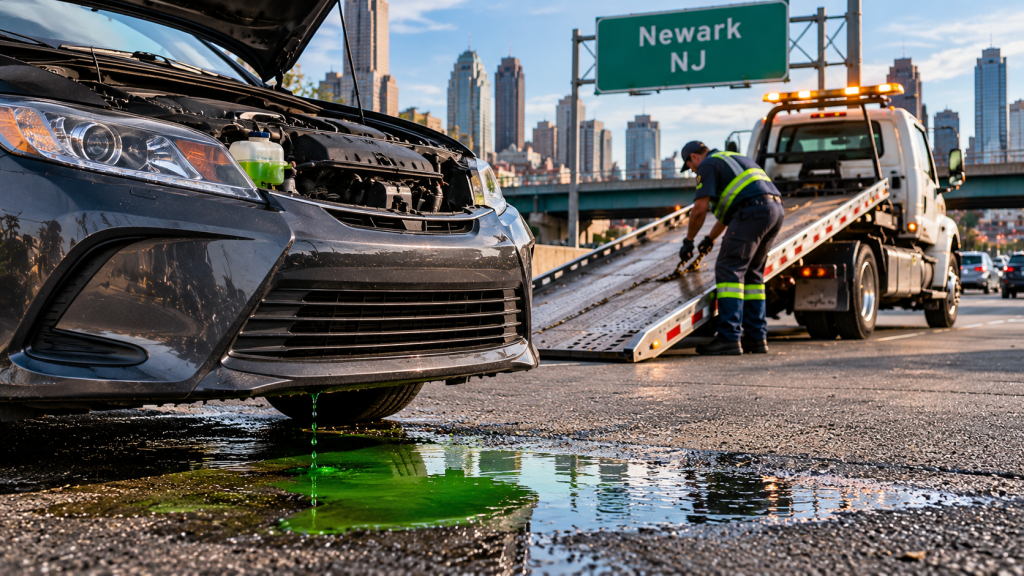
A coolant leak can turn a normal drive into an unexpected roadside problem. If you notice a brightly colored puddle underneath your vehicle, a sweet smell coming from the engine area, or a coolant warning light on your dashboard, your car may be losing engine coolant. Ignoring these warning signs can lead to overheating, engine damage, and an unsafe driving situation.
For drivers dealing with a car leaking coolant in Newark NJ, understanding what to look for and when to stop driving can help prevent a minor problem from becoming an expensive repair. Whether you are commuting through Newark, driving on a busy local road, or traveling through Essex County, knowing when to request professional help is important.
We Care Towing & Transport helps drivers who need towing and vehicle recovery assistance when their cars become unsafe to drive. In this guide, we explain the common causes of coolant leaks, the warning signs to recognize, what to do if your vehicle starts leaking coolant, and when calling a tow truck is the safer option.
What Is Engine Coolant, and Why Does Your Car Need It?
Engine coolant is a specially formulated fluid that helps regulate engine temperature. It circulates through the engine and cooling system, carrying excess heat away from critical components. The radiator then helps release that heat so the engine can operate within its intended temperature range.
When the cooling system loses coolant, the engine may no longer be able to control its temperature properly. Depending on the severity and location of the leak, the problem can develop gradually or become serious during a single trip.
A vehicle may lose coolant because of a damaged hose, a leaking radiator, a worn seal, a faulty water pump, or another cooling-system issue. The exact cause usually requires a proper inspection.
If your vehicle begins showing signs of coolant loss, do not assume that adding more fluid will solve the underlying problem. A leak can continue while you drive, allowing the coolant level to drop again.
7 Common Signs Your Car Is Leaking Coolant
Recognizing the warning signs early can help you decide whether it is safe to continue driving or whether you should arrange professional assistance.
1. A Puddle Under Your Parked Vehicle
One of the most noticeable signs of a coolant leak is a puddle underneath your car. Coolant can come in different colors, including pink, orange, green, blue, or yellow, depending on the product used in the vehicle.
However, color alone cannot confirm that a liquid is coolant. Other automotive fluids can also leave puddles underneath a vehicle.
If you notice an unfamiliar liquid, park safely and look for other warning signs. Avoid touching or tasting the fluid, and keep children and pets away from it.
2. A Sweet Smell Around the Vehicle
Some engine coolants have a distinctive sweet odor. If you notice an unusual sweet smell near the front of your car, under the hood, or inside the cabin, it may indicate a cooling-system leak.
Do not lean over a hot engine to investigate the smell. A professional mechanic can inspect the cooling system and identify the source.
3. The Temperature Gauge Rises
An engine temperature gauge that climbs above its normal range can indicate a cooling-system problem. If the coolant level has dropped significantly, the engine may begin overheating.
If the temperature gauge enters the danger zone or a high-temperature warning appears, pull over as soon as it is safe to do so and switch off the engine. Continuing to drive an overheating vehicle may cause serious damage.
If you experience overheating along with a suspected coolant leak, arrange professional assistance instead of trying to reach a repair shop under your own power.
4. A Low-Coolant Warning Appears
Some vehicles have a dashboard warning light or message that indicates a low coolant level. Never ignore this warning, particularly if it appears together with a rising temperature gauge or visible fluid loss.
The warning may indicate a leak, a low fluid level, or another cooling-system issue. Check your owner’s manual for the correct warning procedure.
5. Steam Comes From Under the Hood
Steam coming from the engine compartment can be a sign of overheating or hot coolant escaping from the cooling system.
Pull over safely, turn off the engine, and stay clear of the hot engine compartment. Never remove the radiator cap or a pressurized coolant reservoir cap while the engine is hot. Hot coolant and steam can cause severe burns.
If steam continues or the vehicle has overheated, do not attempt to drive it to a repair shop. Request towing assistance.
6. You Need to Refill Coolant Repeatedly
Coolant levels can change slightly under certain conditions, but repeatedly needing to add coolant may indicate a leak or another cooling-system problem.
If the level keeps dropping, do not rely on repeated refills as a permanent solution. The system needs to be inspected to determine why the coolant is disappearing.
7. Your Vehicle Overheats More Than Once
Repeated overheating is a serious warning sign. Even if the temperature returns to normal after the car cools down, the underlying problem may still exist.
If your vehicle has overheated repeatedly, avoid further driving until it has been inspected. A tow can help you transport the vehicle without risking additional engine damage.
What Causes a Coolant Leak?
There are several possible reasons a vehicle may leak coolant. Identifying the source is important because different problems require different repairs.
Damaged or Worn Coolant Hoses
Coolant hoses carry fluid between the engine, radiator, and other cooling-system components. Over time, heat, age, and wear can cause hoses to crack, weaken, or develop leaks.
A damaged hose may leak slowly at first but lose more fluid as the engine warms up. If the leak is significant, the vehicle may overheat quickly.
A Leaking Radiator
The radiator helps remove heat from the engine coolant. Corrosion, physical damage, or worn connections can cause it to leak.
A radiator leak may leave fluid near the front of the vehicle. However, the exact location of a puddle does not always reveal where the leak originates because fluid can travel along other components.
A Faulty Water Pump
The water pump circulates coolant through the engine and cooling system. If its seals or other components wear out, coolant may begin leaking.
A water-pump problem may also affect coolant circulation. Because this can lead to overheating, professional inspection is important.
A Damaged Coolant Reservoir
The coolant reservoir stores and accommodates coolant as the engine temperature changes. Cracks, damaged connections, or a faulty cap can cause fluid loss.
Even if the reservoir is the source, the system should be checked to make sure there are no additional problems.
A Worn Gasket or Internal Engine Problem
In some cases, coolant loss can be associated with a gasket failure or another internal engine issue. These problems may not produce an obvious puddle underneath the car.
Unexplained coolant loss, persistent overheating, or other unusual engine symptoms should be investigated by a qualified mechanic rather than diagnosed from appearance alone.
What Should You Do If Your Car Is Leaking Coolant in Newark, NJ?
If you suspect a coolant leak while driving around Newark, taking the right steps can help protect you and your vehicle.
1. Find a safe place to stop. If you notice overheating, steam, or a temperature warning, move out of traffic as soon as it is safe. Do not make sudden maneuvers or stop in a dangerous lane if you can safely reach a better location.
2. Switch off the engine. Once safely parked, turn off the engine if overheating or a significant coolant leak is suspected. This helps prevent additional heat buildup.
3. Do not open the hot cooling system. Never remove a radiator cap or pressurized coolant reservoir cap while the engine is hot. Hot fluid and steam can escape forcefully and cause burns.
4. Avoid continuing your journey. A vehicle that is losing coolant may overheat without much warning. Driving farther to reach a mechanic could increase the risk of engine damage.
5. Arrange a professional inspection. A mechanic can diagnose the leak and determine whether a hose, radiator, water pump, reservoir, gasket, or another component needs repair.
6. Request towing if the vehicle is unsafe to drive. If the engine has overheated, steam is visible, the coolant level is dropping rapidly, or the vehicle cannot maintain a safe temperature, professional towing is a sensible option.
For related guidance, read our article on car overheating in Newark, NJ and learn when it is safer to stop driving and request assistance.
When Should You Call a Tow Truck for a Coolant Leak?
Not every coolant leak has the same severity, but certain symptoms mean you should avoid driving and arrange transportation for your vehicle.
Consider calling for towing when:
- Your temperature gauge indicates overheating.
- Steam is coming from under the hood.
- Coolant is leaking rapidly or forming a large puddle.
- The low-coolant warning returns shortly after the fluid level is addressed.
- The engine overheats repeatedly.
- You notice unusual engine behavior along with coolant loss.
- You are stranded somewhere unsafe and cannot confidently move the vehicle to a safer location.
If the vehicle is already overheating, do not restart the engine simply to move it a short distance. Wait in a safe place away from traffic and follow the advice of a qualified professional.
Drivers who need emergency towing in Newark NJ should explain the symptoms and their exact safe pickup location when requesting assistance. Mentioning the overheating warning, visible leak, or steam can help the towing provider understand the situation.
For more information about professional transport, visit our car towing service in Newark, NJ page.
Why Professional Towing Can Help Protect Your Vehicle
When a cooling-system problem makes a car unsafe to drive, towing can help get it to a repair facility without adding unnecessary mileage or engine operation.
The appropriate towing method depends on the vehicle, its condition, drivetrain, and the manufacturer’s requirements. A professional towing provider can assess the situation and determine a suitable transport method.
Professional towing may be particularly useful when:
- The vehicle is stranded on a busy road.
- The engine has overheated.
- A coolant leak appears severe.
- The car cannot be driven safely.
- You need transportation to a mechanic or repair shop.
If your vehicle requires a specific loading or transport method, tell the towing provider about the vehicle type and any visible damage before pickup. You can also learn more about our flatbed towing service in Newark, NJ.
How to Reduce the Risk of Coolant Leaks
Although not every coolant-system problem can be prevented, routine maintenance can help identify developing issues.
- Follow your maintenance schedule: Have the cooling system inspected according to the manufacturer’s recommendations.
- Check coolant levels safely: Follow your owner’s manual and only inspect or open the system when it is cool.
- Look for visible leaks: Pay attention to unexplained puddles under your parked vehicle.
- Watch dashboard warnings: Respond promptly to low-coolant and engine-temperature alerts.
- Address unusual smells or steam: Do not ignore signs that fluid may be escaping.
- Use the correct coolant: Follow the manufacturer’s specifications instead of mixing incompatible coolant types.
- Get recurring problems checked: Repeated coolant loss deserves a proper diagnosis rather than repeated refilling.
These precautions can help you notice warning signs earlier, but they cannot guarantee that a leak will not occur.
Frequently Asked Questions
Can I drive my car if it is leaking coolant?
It depends on the severity and the vehicle’s condition. A suspected leak combined with overheating, steam, or a temperature warning means you should stop safely and switch off the engine. Do not continue driving an overheating vehicle. Arrange professional assistance if it is unsafe to drive.
How do I know if the liquid under my car is coolant?
Coolant may be brightly colored and can have a sweet smell, but appearance alone is not enough to identify it reliably. Do not touch or taste an unknown fluid. A mechanic can inspect the vehicle and confirm the source.
Can a coolant leak cause engine damage?
Yes. If coolant loss causes the engine to overheat, continued operation can result in serious engine damage. The risk depends on the leak, the amount of coolant lost, and how long the engine operates while overheated.
Should I add coolant if my car is leaking?
Do not treat adding coolant as a permanent fix. Follow your owner’s manual and never open a hot, pressurized cooling system. If the vehicle is overheating or losing coolant rapidly, switch off the engine and seek professional help.
When should I call a towing company in Newark, NJ?
Call for towing if the vehicle is overheating, producing steam, leaking coolant rapidly, or otherwise unsafe to drive. If you are stranded near traffic, prioritize your safety and move to a safe location if possible.
Does We Care Towing & Transport help with vehicles that cannot be driven?
We Care Towing & Transport provides towing and vehicle recovery assistance in Newark, NJ. If a coolant leak leaves your vehicle unsafe to drive, contact the company to discuss the vehicle’s condition and towing requirements.
Need Towing Assistance in Newark, NJ?
A coolant leak may begin as a small puddle, but it can become a serious problem if it causes your engine to overheat. Recognizing the warning signs, stopping safely, and avoiding unnecessary engine operation can help reduce the risk of further damage.
If your car is leaking coolant, overheating, or stranded on the road, We Care Towing & Transport is here to help with towing and vehicle recovery assistance in Newark, New Jersey, and surrounding service areas.
Visit We Care Towing & Transport to learn more about our services, or explore our towing services to find the assistance you need.
Stay safe, take warning signs seriously, and arrange professional help when your vehicle is no longer safe to drive.