
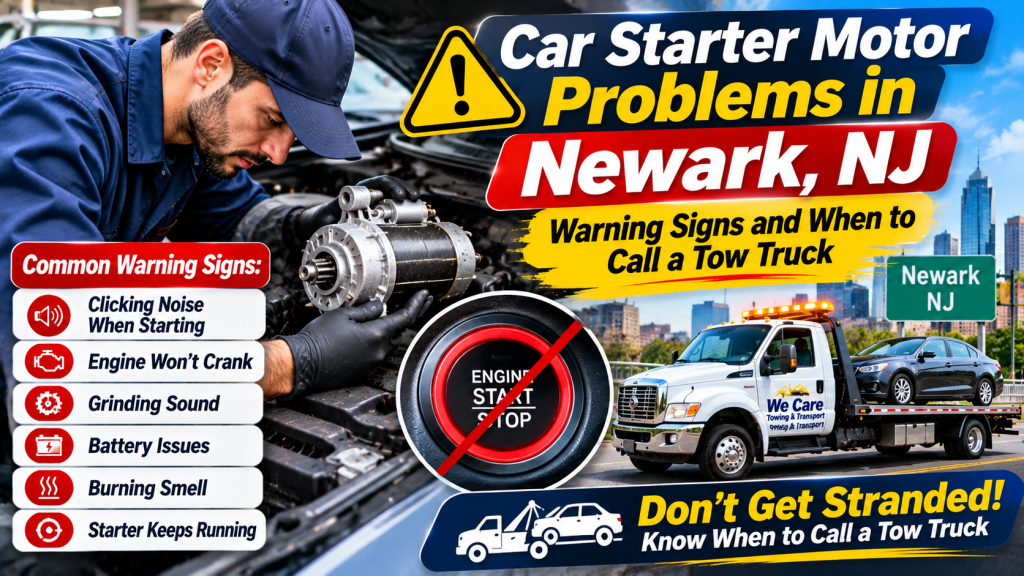
You get into your car, turn the key or press the start button, and expect the engine to start. Instead, you hear a clicking noise, notice the dashboard lights turning on, or experience absolutely no response from the engine.
A vehicle that refuses to start can disrupt your entire day, especially when you are parked outside your workplace, at a shopping center, in a residential parking lot, or along a busy street in Newark, NJ.
One possible reason is a problem with the starter motor.
The starter motor is an important part of your vehicle’s starting system. When it fails, the engine may not crank, even if other electrical components appear to work normally.
However, a no-start condition does not automatically mean the starter motor is defective. Battery problems, electrical connections, ignition issues, and other components can produce similar symptoms.
In this guide, we explain common car starter motor problems in Newark, NJ, their warning signs, possible causes, and when calling a professional towing service may be the safer option.
What Does a Car Starter Motor Do?
A starter motor is an electric motor that helps turn the engine over when you start your vehicle.
When you turn the ignition key or press the start button, the vehicle’s starting system activates the starter motor.
The starter motor engages with the engine’s flywheel or flexplate and rotates the engine until it can begin running independently.
Once the engine starts, the starter motor disengages.
If the starter motor or its related electrical components stop working correctly, the engine may fail to crank.
Modern vehicles may use different starting systems, including conventional starter motors and integrated starter-generator systems. The exact design depends on the vehicle.
7 Common Signs of Starter Motor Problems
Starter motor problems can appear suddenly or develop gradually.
Recognizing the warning signs can help you understand when your vehicle needs professional attention.
1. Clicking Noise When Starting the Car
One common symptom of a starting system problem is a clicking sound when you turn the ignition key or press the start button.
You might hear:
- A single loud click
- Several rapid clicks
- Repeated clicking without engine cranking
A single click may indicate a starter solenoid or starter motor problem.
Rapid clicking can also occur when the battery does not have enough power or electrical connections are poor.
Because different problems can create similar sounds, a proper inspection is necessary before replacing any component.
2. Engine Does Not Crank
When you attempt to start your vehicle, you may notice that the dashboard lights turn on but the engine does not rotate.
This is commonly called a no-crank condition.
Possible causes include:
- Failed starter motor
- Weak or discharged battery
- Loose battery terminals
- Faulty starter relay
- Damaged electrical wiring
- Ignition switch problems
- Neutral safety switch issues
If the engine does not crank after basic checks, avoid repeatedly attempting to start the vehicle.
Arrange professional diagnosis to identify the actual problem.
3. Intermittent Starting Problems
Does your car sometimes start normally but refuse to start on another attempt?
Intermittent starting problems can be difficult to diagnose because the issue may not happen every time.
Possible causes include:
- Worn starter motor components
- Loose electrical connections
- Starter relay problems
- Battery issues
- Faulty ignition components
A starter motor that works inconsistently should not be ignored.
If the vehicle becomes unreliable, arrange an inspection before you become stranded in an inconvenient or unsafe location.
4. Grinding Noise During Startup
A grinding sound when starting your vehicle may indicate a problem involving the starter motor’s engagement with the engine’s flywheel or flexplate.
Possible causes include:
- Worn starter drive gear
- Damaged flywheel teeth
- Incorrect starter engagement
- Loose or improperly installed starter components
Do not continue attempting to start the engine if you hear repeated grinding noises.
Further attempts may increase the risk of damage to related components.
5. Starter Motor Keeps Running After the Engine Starts
The starter motor should disengage once the engine starts.
If you hear the starter continuing to operate after the engine has started, there may be a problem with the starter solenoid, relay, ignition switch, or related electrical system.
This condition should be addressed promptly because continued starter operation can damage components.
If the starter remains engaged, stop using the vehicle and arrange professional assistance.
6. Dashboard Lights Turn On but the Engine Will Not Start
Sometimes the dashboard and interior lights work normally, but the engine refuses to crank.
This can make drivers suspect the starter motor immediately.
However, working dashboard lights do not prove that the battery is healthy.
Starting the engine requires significantly more electrical power than operating many dashboard components.
Possible causes include:
- Weak battery
- Poor battery connections
- Failed starter motor
- Starter circuit problems
- Faulty electrical connections
A qualified technician can test the battery and starting system to determine the source of the problem.
7. Burning Smell When Attempting to Start the Vehicle
A burning smell near the engine compartment during repeated starting attempts may indicate an electrical or mechanical problem.
Possible causes include overheating electrical connections, damaged wiring, or a starter motor that is drawing excessive current.
If you notice smoke or a strong burning smell, stop attempting to start the vehicle.
Move to a safe location and seek professional assistance.
If there is fire or an immediate safety risk, contact emergency services.
What Causes Starter Motor Failure?
Starter motors are designed to operate under demanding conditions, but they can eventually wear out or develop electrical problems.
Here are some common reasons a starter motor may fail.
1. Normal Wear and Tear
Starter motors contain moving electrical and mechanical components.
Over time, repeated starting cycles can contribute to wear.
Depending on the vehicle and operating conditions, internal components may eventually require repair or replacement.
2. Weak or Discharged Battery
A weak battery may not provide sufficient electrical power to operate the starter motor correctly.
You may notice clicking sounds, slow cranking, or no response when starting the vehicle.
Before replacing the starter motor, the battery should be tested.
3. Corroded Battery Terminals
Corrosion on battery terminals can interfere with electrical connections.
Loose or damaged battery cables can also prevent sufficient current from reaching the starter motor.
A technician can inspect the battery terminals and connections to determine whether cleaning, tightening, or replacement is necessary.
4. Faulty Starter Solenoid
The starter solenoid helps control the electrical current supplied to the starter motor and its engagement mechanism.
If the solenoid fails, the starter motor may not operate correctly.
Symptoms can include clicking noises or an engine that refuses to crank.
5. Electrical Wiring Problems
Damaged wires, poor grounding, loose connections, or a faulty starter relay may interrupt the starting circuit.
These issues can sometimes create symptoms that look similar to a failed starter motor.
Professional electrical testing can help identify the actual cause.
6. Ignition Switch Problems
The ignition switch or start-button control system sends the signal required to initiate the starting process.
If the switch or related control system malfunctions, the starter motor may not receive the correct activation signal.
This is another reason why proper diagnosis is important.
Is It Safe to Drive With a Bad Starter Motor?
A starter motor is mainly needed to start the engine. Once the engine is running, the starter motor normally disengages.
This means a vehicle with a developing starter problem may sometimes continue running normally after it has started.
However, there is an important concern: if the engine shuts off or you switch it off, you may not be able to restart it.
A starter problem should be inspected promptly, especially if starting has become unreliable.
Avoid driving if the vehicle has additional symptoms such as:
- Smoke or a burning electrical smell
- Repeated grinding noises
- Electrical system problems
- Engine stalling
- Other serious mechanical warning signs
If your car cannot start in a safe location, arrange roadside assistance or towing rather than repeatedly attempting to crank the engine.
What Should You Do When Your Car Will Not Start in Newark, NJ?
If your vehicle refuses to start, follow these practical steps.
Step 1: Move to a Safe Location
If your vehicle is parked in a traffic lane or another hazardous area, prioritize your safety.
Turn on the hazard lights if they work.
Move away from moving traffic when it is safe to do so.
If your vehicle is in a dangerous roadside position, contact emergency services when appropriate.
Step 2: Observe What Happens When You Start the Car
Pay attention to the symptoms.
For example:
- Does the engine make a clicking sound?
- Does the engine crank slowly?
- Do the dashboard lights turn on?
- Is there a grinding noise?
- Does absolutely nothing happen?
- Do you notice smoke or a burning smell?
These details may help a technician understand the problem.
Step 3: Avoid Repeated Starting Attempts
Repeatedly turning the key or pressing the start button may further drain the battery or increase stress on an already damaged component.
If you hear grinding or notice smoke, stop immediately.
Step 4: Check for Obvious Battery Problems
If it is safe, check whether the battery terminals appear loose or heavily corroded.
Do not touch damaged wiring or attempt electrical repairs without appropriate knowledge.
If the battery is discharged, a suitable jump-start may help.
However, if the problem involves the starter motor or another component, jump-starting may not resolve it.
Step 5: Contact Roadside Assistance or a Towing Provider
If the vehicle still will not start, arrange professional assistance.
Explain what happens when you attempt to start the engine and share your vehicle’s location.
If the issue cannot be resolved safely at the roadside, towing may be necessary.
When Should You Call a Tow Truck for Starter Motor Problems?
Not every starting problem requires towing. Sometimes a battery issue can be resolved with suitable roadside assistance.
However, consider calling a professional towing service when:
- Your vehicle repeatedly refuses to start.
- The starter motor makes loud grinding noises.
- You notice smoke or a burning electrical smell.
- The engine does not crank despite appropriate battery checks.
- The vehicle has an intermittent starting problem and cannot be relied upon.
- The vehicle is stranded in a parking lot or roadside location.
- A technician determines that the vehicle needs transportation to a repair facility.
A towing provider can help transport your vehicle to a suitable mechanic or repair shop.
For general vehicle towing assistance, visit our car towing service in Newark, NJ.
Is Flatbed Towing Suitable for a Car That Will Not Start?
Flatbed towing may be an appropriate option for a vehicle that cannot start or move under its own power.
During flatbed transportation, the vehicle is loaded onto the truck’s platform rather than being driven to the repair facility.
It may be suitable when:
- The starter motor has failed.
- The vehicle cannot crank or start.
- The car has additional mechanical problems.
- The vehicle needs transportation over a longer distance.
- The vehicle manufacturer recommends all wheels off the ground.
The appropriate towing method depends on the vehicle’s drivetrain, condition, and manufacturer’s instructions.
For AWD and 4WD vehicles, the correct towing procedure is particularly important.
Learn more about our flatbed towing service in Newark, NJ.
How to Reduce the Risk of Starter Motor Problems
Although starter motor failure cannot always be prevented, proper maintenance may help reduce the risk of unexpected starting problems.
Check Your Battery Regularly
Have the battery tested periodically, especially if the engine starts slowly or the battery is several years old.
Keep Battery Connections Clean
Battery terminals should be properly connected and free from excessive corrosion.
If you notice damaged terminals or cables, arrange professional inspection.
Avoid Repeated Cranking
If your vehicle does not start after a few reasonable attempts, investigate the cause rather than continuously operating the starter.
Pay Attention to Warning Signs
Clicking noises, grinding sounds, slow cranking, and intermittent starting should be checked early.
Follow Your Vehicle’s Maintenance Schedule
Regular vehicle inspections can help identify battery, electrical, and starting-system problems before they leave you stranded.
Why Choose We Care Towing & Transport in Newark, NJ?
A vehicle that refuses to start can leave you stranded at an inconvenient time or location.
We Care Towing & Transport serves drivers in Newark, NJ, who need vehicle towing and roadside assistance.
Whether your vehicle has a starting-system problem, a mechanical failure, or another issue that prevents safe driving, it is important to arrange suitable transportation.
When requesting towing assistance, provide:
- Vehicle make and model
- Your exact location
- Whether the engine cranks
- Any clicking or grinding noises
- Whether the dashboard lights work
- Any visible smoke or burning smell
Providing these details helps the towing provider understand the situation and consider appropriate equipment.
Visit We Care Towing & Transport to learn more about our towing services.
Frequently Asked Questions (FAQs)
1. What are the common symptoms of a bad starter motor?
Common symptoms include clicking noises, an engine that does not crank, intermittent starting, grinding noises during startup, and a starter motor that continues running after the engine starts.
2. Can a car have working dashboard lights but a bad starter motor?
Yes. Dashboard lights may work even when the starter motor or its electrical circuit is not functioning properly. A weak battery can also cause this situation.
3. Does a clicking sound always mean the starter motor is bad?
No. Clicking can also be caused by a weak battery, loose battery terminals, poor electrical connections, or starter circuit problems. Proper testing is needed to identify the cause.
4. Can I jump-start a car with a bad starter motor?
A jump-start may help if the battery is discharged. However, it generally will not repair a defective starter motor or another failed starting-system component.
5. How long does a starter motor last?
Starter motor lifespan varies depending on vehicle design, usage, maintenance, and operating conditions. There is no single replacement interval that applies to every vehicle.
6. Should I keep trying if my car makes a grinding noise when starting?
No. Repeated grinding during startup may indicate an engagement problem involving the starter drive or flywheel. Stop attempting to start the engine and arrange professional inspection.
7. When should I call a tow truck for a car that will not start?
Consider towing if the vehicle cannot be started after appropriate checks, has serious electrical symptoms, makes repeated grinding noises, or cannot be safely moved from its location.
Final Thoughts
A properly functioning starter motor is essential for getting your vehicle’s engine running.
Warning signs such as clicking noises, slow cranking, grinding sounds, and intermittent starting should not be ignored.
If your vehicle refuses to start in Newark, NJ, avoid repeatedly attempting to crank the engine without understanding the problem.
Arrange a professional inspection and consider towing if the vehicle cannot be moved safely.
We Care Towing & Transport is here to help Newark-area drivers with their vehicle towing needs.