
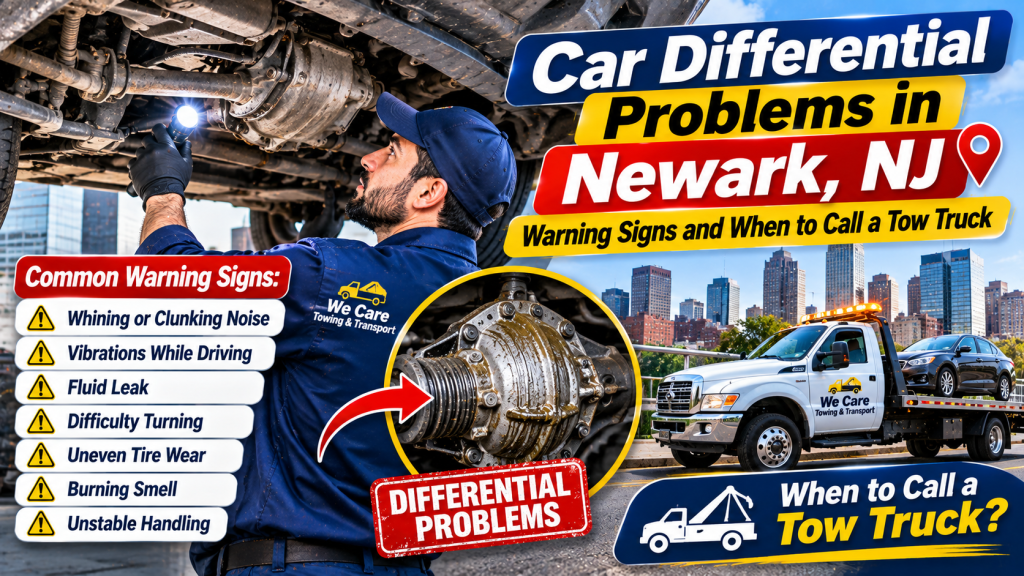
Your vehicle’s differential is an important part of its drivetrain. It helps distribute engine power to the wheels while allowing them to rotate at different speeds, especially when turning.
When the differential develops a problem, you may notice unusual noises, vibrations, fluid leaks, or difficulty turning your vehicle smoothly.
For drivers in Newark, NJ, these symptoms can become especially concerning when driving through busy streets, making turns, or traveling on highways.
Ignoring serious differential problems may lead to additional drivetrain damage and potentially make your vehicle unsafe to drive.
In this guide, we explain what a car differential does, common warning signs of differential problems, possible causes, and when professional towing may be the safer option.
What Is a Car Differential?
A differential is a mechanical component found in a vehicle’s drivetrain. Its primary job is to transfer power to the drive wheels while allowing the wheels on the same axle to rotate at different speeds.
This is particularly important when your vehicle turns.
For example, when taking a corner, the outside wheel travels a longer distance than the inside wheel. The differential allows these wheels to rotate at different speeds while maintaining power delivery.
Depending on your vehicle’s drivetrain, it may have a front differential, rear differential, or multiple differentials.
Differential designs and locations vary depending on whether a vehicle is front-wheel drive, rear-wheel drive, all-wheel drive, or four-wheel drive.
7 Common Signs of Car Differential Problems
Differential problems can develop gradually or appear after a mechanical failure or significant impact.
Here are seven warning signs drivers should recognize.
1. Whining or Howling Noise While Driving
One possible sign of differential trouble is a whining or howling noise coming from the drivetrain area.
You may notice the sound becoming louder as your vehicle accelerates or changes speed.
Possible causes include:
- Worn differential bearings
- Incorrect gear contact
- Low differential fluid
- Damaged internal gears
However, similar noises can also come from wheel bearings, tires, or transmission components.
A professional inspection is necessary to identify the actual source.
If the noise becomes severe or is accompanied by vibration, avoid continuing to drive until the vehicle has been assessed.
2. Clunking Sounds When Accelerating or Changing Direction
A clunking sound when accelerating, releasing the accelerator, or changing between forward and reverse may indicate excessive movement or wear within the drivetrain.
Possible causes include:
- Worn differential components
- Damaged gears
- Worn drivetrain mounts
- Loose or damaged driveshaft components
- Worn universal joints
Not every clunking noise indicates differential failure.
However, repeated or increasingly loud noises should be inspected before additional damage occurs.
3. Vibrations While Driving
Unusual vibrations may indicate a problem involving the drivetrain.
You might notice vibration when accelerating, maintaining speed, or driving at certain speeds.
Possible causes include:
- Worn differential bearings
- Damaged driveshaft components
- Worn CV joints
- Drivetrain imbalance
- Other transmission-related problems
If the vibration becomes severe or affects your ability to control the vehicle, pull over safely and arrange professional assistance.
4. Differential Fluid Leaking
Differential fluid helps lubricate and protect internal gears and bearings.
A leak may develop around seals, gaskets, or other connections.
Possible warning signs include:
- Dark or oily fluid underneath the vehicle
- Wetness around the differential housing
- Unusual drivetrain noises
- Visible fluid loss
The fluid’s appearance alone cannot confirm that it came from the differential. Engine oil, transmission fluid, and other automotive fluids can sometimes be mistaken for one another.
If you suspect a differential fluid leak, arrange an inspection.
Driving with insufficient differential lubrication may cause serious internal damage.
5. Difficulty Turning Smoothly
The differential allows the drive wheels to rotate at different speeds when your vehicle turns.
If a differential or related drivetrain component develops a problem, you may notice unusual resistance, noises, or jerking during turns.
Possible causes include:
- Internal differential damage
- Incorrect differential fluid
- Worn drivetrain components
- Problems involving an electronically controlled differential
If the vehicle feels like it is binding or resisting during turns, avoid forcing it to continue moving.
6. Burning Smell Near the Drivetrain
A burning smell may indicate overheating or another mechanical problem.
In some situations, insufficient differential lubrication or excessive friction can contribute to overheating.
Other possible sources include:
- Overheated transmission components
- Oil leaking onto hot exhaust parts
- Overheated brakes
- Other drivetrain problems
Do not assume the smell automatically means the differential has failed.
If the smell is strong, smoke is visible, or warning lights appear, stop in a safe location and seek professional assistance.
7. Metal Particles in Differential Fluid
Metal particles in used differential fluid may indicate internal component wear.
During a professional inspection or fluid service, a mechanic may find metal debris in the lubricant.
This can be associated with:
- Worn gears
- Bearing damage
- Internal component deterioration
A small amount of fine material may be assessed differently from larger metal fragments.
A qualified mechanic should inspect the fluid and determine whether repairs are necessary.
What Causes Differential Problems?
Differential components experience mechanical stress during everyday driving.
Several factors may contribute to damage.
1. Low or Incorrect Differential Fluid
Differential fluid lubricates internal gears and bearings.
If the fluid level becomes too low or the wrong fluid is used, internal components may experience increased friction and wear.
Follow the vehicle manufacturer’s recommended fluid type and maintenance schedule.
2. Normal Wear and Tear
Differential gears, bearings, seals, and other components can wear over time.
Vehicle age, mileage, driving habits, and maintenance history can influence how quickly these components deteriorate.
Regular maintenance can help identify developing issues.
3. Heavy Loads and Towing Stress
Repeatedly carrying excessive weight or towing beyond the vehicle’s rated capacity can increase drivetrain stress.
Always follow the manufacturer’s towing and load recommendations.
4. Damaged Seals and Gaskets
Seals and gaskets help prevent differential fluid from escaping.
When they become worn or damaged, fluid leaks may develop.
If a leak is ignored, the resulting fluid loss may eventually affect lubrication.
5. Lack of Regular Maintenance
Ignoring recommended drivetrain inspections and fluid service may allow developing problems to go unnoticed.
Check your owner’s manual for the maintenance schedule applicable to your vehicle.
Is It Safe to Drive With a Bad Differential?
It depends on the type and severity of the problem.
Some minor issues may allow a vehicle to move temporarily, but serious differential damage can affect power delivery, handling, and drivetrain reliability.
You should avoid driving if:
- Your vehicle makes loud grinding or howling noises.
- Severe vibration occurs during acceleration.
- The vehicle jerks or binds during turns.
- A significant fluid leak is visible.
- You notice smoke or a strong burning smell.
- The vehicle struggles to move normally.
- You suspect a mechanical component has broken.
Continuing to drive with serious drivetrain problems may increase repair costs and create a safety risk.
If the vehicle feels unsafe, stop in a safe location and arrange professional inspection or towing.
When Should You Call a Tow Truck for Differential Problems?
Not every unusual drivetrain noise requires immediate towing. However, some symptoms indicate that driving further may be unsafe.
Consider arranging professional towing when:
- Your vehicle makes loud grinding noises.
- The differential appears to have a serious fluid leak.
- The vehicle vibrates severely while moving.
- You experience jerking or binding during turns.
- The vehicle cannot transfer power normally.
- You suspect internal drivetrain damage.
- The vehicle becomes difficult to control.
A professional towing provider can help transport your vehicle to a repair facility for further diagnosis.
If the vehicle has drivetrain damage, flatbed towing may be suitable, depending on the vehicle’s condition and manufacturer requirements.
Learn more about our car towing service in Newark, NJ.
Why Flatbed Towing May Be Suitable for Drivetrain Problems
Flatbed towing transports a vehicle on the platform of a tow truck instead of allowing its wheels to roll along the road during transportation.
It may be appropriate for vehicles with:
- Serious differential damage
- Drivetrain mechanical failure
- Severe vibration or grinding
- Damaged wheels or axles
- Problems that make normal driving unsafe
The correct towing method depends on the vehicle’s drivetrain configuration and condition.
For AWD and 4WD vehicles, following the manufacturer’s towing instructions is particularly important. Some vehicles require all wheels to remain off the ground during transport.
A towing provider should confirm the appropriate method before moving the vehicle.
Learn more about our flatbed towing service in Newark, NJ.
How to Prevent Differential Problems
Although not every mechanical failure can be prevented, proper maintenance can help reduce the risk of premature drivetrain wear.
Check Differential Fluid
Follow the manufacturer’s recommended inspection and fluid replacement intervals.
Do not use an unapproved lubricant.
Pay Attention to Unusual Noises
Whining, grinding, clunking, or repeated drivetrain noises should not be ignored.
Arrange an inspection if the sounds continue or become louder.
Avoid Overloading Your Vehicle
Follow the manufacturer’s vehicle load and towing limits.
Excessive loads can place additional stress on drivetrain components.
Inspect for Fluid Leaks
If you notice oily fluid underneath your vehicle, have the source identified.
Do not assume every leak is engine oil or that every fluid leak is harmless.
Follow Regular Maintenance Schedules
Keep up with recommended inspections and drivetrain servicing.
Early attention may help identify worn seals, fluid problems, and developing mechanical issues.
Why Choose We Care Towing & Transport in Newark, NJ?
When differential or drivetrain damage makes your vehicle unsafe to drive, arranging suitable towing assistance is important.
We Care Towing & Transport serves drivers in Newark, NJ, who need vehicle towing and roadside assistance.
If your vehicle develops unusual drivetrain noises, severe vibration, or other mechanical problems, explain its condition when requesting towing.
Helpful information includes:
- Vehicle make and model
- Drivetrain type, if known
- Whether the vehicle can move
- Any visible fluid leaks
- Unusual noises or vibrations
- Your vehicle’s current location
Providing these details helps the towing provider consider suitable equipment and transportation requirements.
Visit We Care Towing & Transport to learn more about our towing services.
Frequently Asked Questions (FAQs)
1. What are the common signs of a bad differential?
Common warning signs include whining noises, clunking sounds, vibrations, fluid leaks, burning smells, and difficulty turning smoothly.
2. Can I drive with a leaking differential?
Driving with a differential fluid leak may be risky because insufficient lubrication can damage internal components. Have the leak inspected promptly. If the leak is significant or accompanied by unusual noises, arrange towing instead of driving.
3. What causes a differential to make a whining noise?
Possible causes include worn bearings, incorrect gear contact, low lubricant, or internal gear wear. Other drivetrain components can also create similar noises.
4. Is differential damage expensive to repair?
Repair costs depend on the vehicle, the type of differential, the damaged components, and whether internal parts can be repaired or require replacement. A qualified mechanic must inspect the vehicle before providing an accurate estimate.
5. Can differential problems affect steering?
Differential or drivetrain problems may cause unusual resistance, binding, or jerking during turns. These symptoms can also have other causes and should be professionally inspected.
6. Is flatbed towing suitable for a vehicle with differential damage?
Flatbed towing may be suitable because the vehicle is transported with its wheels off the road. The correct method depends on the vehicle’s drivetrain configuration and manufacturer’s towing requirements.
7. When should I call a tow truck for differential problems?
Consider towing if your vehicle has severe grinding noises, major fluid leaks, strong vibrations, drivetrain binding, or difficulty moving safely.
Final Thoughts
Your vehicle’s differential plays an important role in power delivery and smooth turning.
Warning signs such as whining noises, fluid leaks, clunking sounds, and unusual vibrations should never be ignored.
If you experience serious differential or drivetrain problems in Newark, NJ, avoid forcing your vehicle to continue driving.
Arrange a professional inspection and consider towing if the vehicle cannot be moved safely.
We Care Towing & Transport is here to help Newark-area drivers with their vehicle towing needs.