
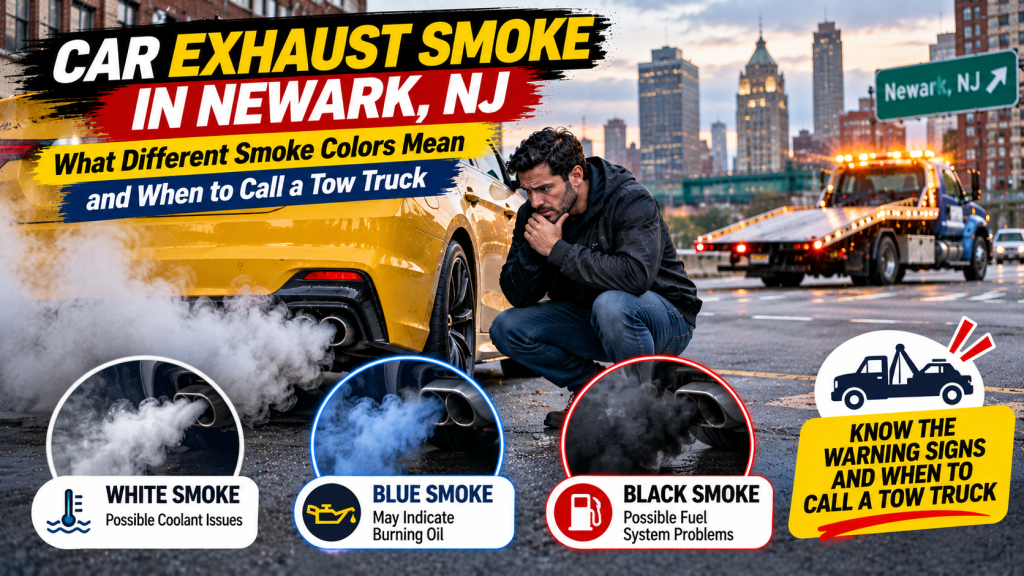
Have you noticed unusual smoke coming from your car’s exhaust while driving around Newark, New Jersey? Whether the smoke is white, blue, or black, its color and behavior may provide important clues about what is happening inside your vehicle.
Some exhaust vapor is normal, especially during cold starts. However, thick, persistent, or unusual exhaust smoke can indicate an engine, cooling system, fuel delivery, or oil-related problem.
If you notice car exhaust smoke in Newark, NJ, it is important to understand the possible causes and recognize when continuing to drive could put your vehicle at risk.
In this guide, We Care Towing & Transport explains what different exhaust smoke colors may mean, what warning signs to watch for, and when professional towing may be the safest option.
Why Is My Car Producing Smoke From the Exhaust?
Your vehicle’s engine burns fuel to generate power. During normal operation, the exhaust system carries combustion gases away from the engine.
When something is not working correctly, the exhaust may produce visible smoke or unusual vapor.
The appearance of the exhaust can offer useful clues:
- White smoke may be ordinary condensation or a possible coolant-related problem.
- Blue or blue-grey smoke may indicate that engine oil is burning.
- Black smoke may suggest excessive fuel or incomplete combustion.
- Thick smoke accompanied by overheating, unusual noises, or loss of power may indicate a serious problem.
Smoke color alone cannot confirm a diagnosis. The vehicle’s condition, engine temperature, warning lights, and other symptoms should also be considered.
1. White Smoke From the Exhaust: Possible Causes
White exhaust vapor is not always a sign of engine damage. In cooler weather, water vapor from normal combustion can condense inside the exhaust system and become visible when the vehicle starts.
This light vapor usually disappears as the exhaust system warms up.
However, thick white smoke that continues after the engine reaches normal operating temperature may indicate a more serious problem.
Possible Reasons for Thick White Smoke
Coolant entering the combustion chamber
A damaged head gasket, cracked cylinder head, or another internal engine problem may allow coolant to enter the combustion chamber.
Possible warning signs include:
- Persistent thick white exhaust smoke
- Unexplained coolant loss
- Engine overheating
- Rough engine operation
- Unusual sweet-smelling exhaust
These symptoms require professional inspection.
Cooling system problems
A cooling system fault may cause overheating, which can lead to serious engine damage if the vehicle continues operating.
If the temperature gauge enters the red zone or a temperature warning appears, stop in a safe location and switch off the engine.
Never open a hot radiator cap or attempt to handle hot cooling-system components.
If the vehicle is overheating and producing persistent white smoke, do not continue driving. Professional towing may help prevent additional damage.
2. Blue Smoke From the Exhaust: Is Your Engine Burning Oil?
Blue or blue-grey exhaust smoke can indicate that engine oil is entering the combustion process and burning.
This may happen because of worn engine components, damaged valve seals, piston ring problems, or certain turbocharger faults.
Common Symptoms of Blue Exhaust Smoke
- Blue smoke when starting the engine
- Smoke during acceleration
- Smoke after prolonged idling
- Decreasing engine oil levels
- Unusual engine performance
- An oil warning light
The timing of the smoke may help a mechanic identify the possible cause.
For example, blue smoke during acceleration may suggest a different oil-related problem from smoke appearing after extended idling.
What Should You Do?
If you notice persistent blue smoke, arrange a professional engine inspection.
If the oil pressure warning light appears, the engine makes severe noises, or the vehicle experiences major power loss, stop driving as soon as it is safe.
Continuing to operate an engine with inadequate oil pressure can cause serious damage.
If the vehicle cannot be driven safely, consider professional towing to a repair facility.
3. Black Smoke From the Exhaust: Possible Fuel System Problems
Black exhaust smoke may indicate that the engine is receiving too much fuel relative to the available air or that combustion is incomplete.
Possible causes include:
- Faulty fuel injectors
- Restricted air filters
- Malfunctioning airflow sensors
- Fuel pressure problems
- Engine management system faults
- Other combustion-related issues
You might also notice poor fuel economy, rough idling, reduced acceleration, or an illuminated check engine light.
Black smoke should not automatically be blamed on one particular component. A diagnostic inspection is needed to identify the actual cause.
Is Black Exhaust Smoke Dangerous?
Persistent black smoke may indicate that the engine is not operating correctly.
If the smoke is accompanied by severe engine performance problems, overheating, or unusual noises, avoid continuing to drive.
Arrange a professional inspection before the issue causes additional damage.
4. Grey Smoke From the Exhaust: What Could It Mean?
Grey exhaust smoke can be difficult to distinguish from blue smoke. Depending on the vehicle, it may indicate burning oil, a fuel-related issue, or a problem involving a turbocharger or other engine component.
In some vehicles, certain operating conditions may also produce temporary visible vapor.
Pay attention to whether the smoke continues, becomes thicker, or appears alongside other symptoms.
Possible warning signs include:
- Unusual oil consumption
- Rough engine performance
- Loss of acceleration
- Burning smells
- Dashboard warning lights
Because grey smoke has several possible explanations, a qualified mechanic should inspect the vehicle rather than relying on its appearance alone.
5. Exhaust Smoke Along With Engine Overheating
Smoke and overheating occurring together should be treated seriously.
A vehicle that overheats may have a cooling system problem, coolant leak, damaged radiator, failing water pump, or another mechanical issue.
If you notice steam from under the hood, a rising temperature gauge, or an overheating warning:
- Reduce speed and move to a safe location when possible.
- Switch off the engine.
- Do not open the radiator cap while the system is hot.
- Keep away from escaping steam and hot components.
- Arrange professional assistance.
Do not continue driving just to reach a nearby repair shop. An overheating engine can suffer extensive damage.
Read our related guide about car overheating in Newark, NJ.
6. Exhaust Smoke With Loss of Engine Power
Sometimes unusual exhaust smoke appears alongside reduced acceleration or engine performance.
This may indicate a problem involving the fuel system, ignition system, turbocharger, cooling system, or internal engine components.
You might notice:
- Slow acceleration
- Engine hesitation
- Rough idling
- Unusual engine noises
- Warning lights
- Repeated engine stalling
If your vehicle is losing power and producing thick or persistent smoke, avoid forcing the engine to continue running.
Stop in a safe location and arrange professional inspection. If the car cannot operate safely, towing may be necessary.
For more information, read our guide on car engine shutting off while driving in Newark, NJ.
7. Exhaust Smoke After a Vehicle Has Been Sitting
A vehicle may produce a small amount of white vapor when started after sitting overnight, particularly in cooler weather.
This is often condensation evaporating from the exhaust system.
However, you should pay attention if:
- The white smoke is thick and persistent.
- Blue or black smoke continues after startup.
- The engine runs roughly.
- The vehicle loses coolant or engine oil.
- Unusual smells accompany the smoke.
A short period of normal condensation is different from continuous abnormal exhaust smoke.
If the smoke does not disappear or is accompanied by warning signs, have the vehicle inspected.
What Should You Do If Your Car Produces Thick Exhaust Smoke in Newark, NJ?
If your vehicle suddenly starts producing unusual smoke, your first priority should be safety.
Step 1: Observe the Smoke Without Taking Risks
Notice the smoke color, thickness, and whether it continues after the engine warms up.
Do not stand behind the exhaust pipe or breathe in the fumes to identify their smell.
Step 2: Watch Your Dashboard
Look for important warning lights, particularly:
- Engine temperature warning
- Oil pressure warning
- Check engine light
- Battery warning light
A warning light accompanied by smoke, unusual noises, or poor performance should not be ignored.
Step 3: Move to a Safe Location
If the vehicle remains controllable, reduce speed gradually and move away from traffic when safe.
Turn on your hazard lights when appropriate.
Avoid stopping in a travel lane or attempting roadside repairs beside moving vehicles.
Step 4: Switch Off the Engine When Necessary
If you notice overheating, severe smoke, oil pressure warnings, or major engine problems, stop safely and switch off the engine.
Do not restart it repeatedly to see whether the smoke disappears.
If there is fire, heavy smoke, or an immediate hazard, move away from the vehicle and contact emergency services.
Step 5: Arrange Professional Assistance
Explain the smoke color, warning lights, and other symptoms to a qualified mechanic or towing provider.
If the vehicle is unsafe to drive, professional towing can help transport it to a repair facility.
Visit our car towing service in Newark, NJ page for more information.
Is It Safe to Drive a Car That Produces Exhaust Smoke?
It depends on the cause and severity.
A small amount of white vapor that disappears after a cold start may be normal. However, thick or persistent smoke can indicate a mechanical problem that requires attention.
Avoid driving if:
- Thick white smoke continues after the engine warms up.
- Blue smoke is accompanied by low oil pressure or severe engine noises.
- Black smoke is accompanied by major performance problems.
- The temperature gauge indicates overheating.
- The engine loses power or repeatedly stalls.
- Smoke appears alongside fluid leaks or burning smells.
If you cannot determine whether the vehicle is safe to operate, stop in a suitable location and seek professional advice.
Continuing to drive with a serious engine problem may cause additional damage.
Why Exhaust Smoke Problems Should Not Be Ignored in Newark Traffic
Newark drivers regularly travel through busy intersections, commercial areas, congested roads, and highway entrances.
An engine problem that begins during a journey may quickly become stressful if the vehicle starts losing power or overheating.
Stopping in a safe location is particularly important when traffic is heavy or visibility is reduced.
If your vehicle produces thick smoke and cannot continue safely, arranging towing is generally a better choice than attempting to reach a repair shop under its own power.
How We Care Towing & Transport Can Help
When engine or exhaust problems leave your vehicle unsafe to drive, We Care Towing & Transport provides towing assistance for drivers in Newark, NJ, and surrounding areas.
A towing professional can help transport an appropriate disabled vehicle to a repair facility or another suitable destination.
The correct towing method depends on the vehicle, its condition, drivetrain, and manufacturer’s requirements.
When requesting assistance, be ready to explain:
- Your exact location or nearest cross street.
- Your vehicle’s make, model, and approximate year.
- Whether the smoke is white, blue, black, or grey.
- Whether the engine is overheating.
- Whether the vehicle has lost power.
- Any dashboard warning lights.
- Whether you notice unusual noises or fluid leaks.
If you notice flames, a strong fuel leak, or another immediate hazard, move away and contact emergency services before arranging vehicle recovery.
Learn more about available services at We Care Towing & Transport.
How to Help Prevent Engine and Exhaust Problems
Not every engine problem can be prevented, but regular maintenance may help identify certain issues before they become serious.
Follow these maintenance practices:
- Check engine oil according to the owner’s manual.
- Monitor coolant levels when the engine is completely cool.
- Follow recommended oil and filter replacement intervals.
- Replace air filters according to manufacturer recommendations.
- Investigate persistent exhaust smoke.
- Address engine warning lights promptly.
- Have recurring overheating inspected.
- Avoid driving when serious engine symptoms appear.
Routine inspections can help identify developing problems and support more reliable vehicle operation.
Frequently Asked Questions
1. What does white smoke from a car exhaust mean?
Thin white vapor that disappears after startup may be normal condensation. Thick, persistent white smoke may indicate coolant entering the combustion chamber or another engine problem.
2. What does blue smoke from a car exhaust mean?
Blue or blue-grey smoke may indicate that engine oil is burning. Possible causes include worn piston rings, valve seals, or certain turbocharger problems.
3. Why is my car producing black smoke?
Black smoke may indicate excessive fuel or incomplete combustion. Fuel injectors, airflow sensors, restricted air filters, or other engine-management problems may be involved.
4. Should I drive if my car is producing thick white smoke?
If the smoke is thick and persistent, particularly when accompanied by overheating or coolant loss, stop in a safe location and arrange professional inspection rather than continuing to drive.
5. Can exhaust smoke mean my engine is damaged?
Yes, persistent unusual exhaust smoke can indicate an internal engine problem, but it can also have other causes. A proper diagnostic inspection is necessary.
6. Can a tow truck transport a car that produces smoke?
Yes, an appropriate disabled vehicle may be transported for inspection. Inform the towing provider about the smoke, overheating, fuel leaks, or other hazards before arranging recovery. If there is fire or an immediate danger, contact emergency services first.
7. Where can I get towing assistance in Newark, NJ?
Visit We Care Towing & Transport to learn about towing assistance for disabled vehicles in Newark and nearby areas.
Final Thoughts
Unusual exhaust smoke can be an important warning sign of a problem involving your engine, fuel system, cooling system, or oil circulation.
If you notice car exhaust smoke in Newark, NJ, pay attention to its color, whether it continues, and whether other warning signs appear.
Do not continue driving if your vehicle is overheating, losing power, producing thick persistent smoke, or showing serious engine symptoms.
When your car cannot be driven safely, We Care Towing & Transport can help you explore towing assistance so your vehicle can be transported for professional inspection.
Your vehicle’s warning signs matter. Address unusual exhaust smoke promptly and put safety first.
Learn more at wecaretransportnj.com.