
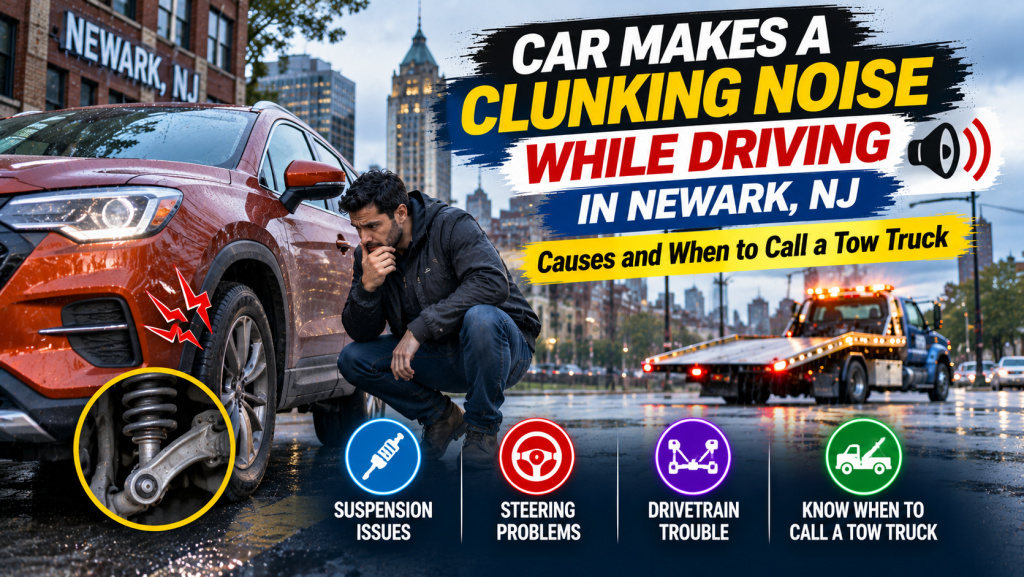
Hearing a loud clunking noise while driving can be alarming, especially when you are navigating busy streets in Newark, New Jersey. You may hear a single clunk when going over a bump, a repeated knocking sound while turning, or a loud impact noise when accelerating or braking.
A car making a clunking noise while driving in Newark, NJ, may have a suspension problem, a loose component, a worn drivetrain part, or another mechanical issue. Although some noises may have a minor cause, others can indicate a problem that affects vehicle stability and safety.
Ignoring unusual noises can allow certain mechanical problems to worsen. Understanding when to stop driving and seek professional assistance can help protect you and other road users.
In this guide, We Care Towing & Transport explains common causes of clunking noises, warning signs to watch for, and when professional towing may be the safest option.
What Does a Clunking Noise From a Car Mean?
A clunking noise is usually a dull, heavy sound that may occur when the vehicle moves, turns, accelerates, brakes, or travels over uneven pavement.
The timing of the noise can help a mechanic narrow down possible causes, but it cannot confirm which component has failed.
You might notice:
- A clunk when driving over potholes or bumps.
- A loud knock when turning the steering wheel.
- A clunk when accelerating from a stop.
- A noise when shifting between drive and reverse.
- A clunk when applying the brakes.
- Repeated noises accompanied by vibration.
- Changes in handling or steering stability.
If the noise is sudden, loud, or accompanied by difficulty controlling the vehicle, do not continue driving simply to see whether it disappears.
7 Common Reasons Your Car Makes a Clunking Noise
1. Worn Suspension Components
Your vehicle’s suspension helps absorb road impacts and maintain contact between the tires and the road. Components such as control arm bushings, ball joints, and stabilizer bar links can wear out or become damaged.
When these parts develop excessive movement, you may hear a clunk when driving over potholes, uneven pavement, or speed bumps.
Other symptoms may include unusual tire wear, vibration, or changes in handling.
A suspension noise should not automatically be attributed to one particular part. A qualified mechanic can inspect the suspension and determine what needs repair.
If the vehicle feels unstable or the noise is severe, stop in a safe location and arrange professional assistance.
2. Damaged or Worn Ball Joints
Ball joints connect certain suspension components and allow controlled movement as the wheels turn and the suspension travels.
A worn or damaged ball joint may produce clunking noises, especially when going over bumps or changing direction. Other symptoms can include loose steering or abnormal tire wear.
A severely damaged ball joint can compromise vehicle control. This is not a problem to ignore or investigate by driving the car repeatedly.
If you hear a loud clunk accompanied by loose steering, unusual wheel movement, or unstable handling, avoid driving and arrange an inspection and appropriate towing.
3. CV Joint or Drivetrain Problems
Constant-velocity (CV) joints help transfer power to the wheels while accommodating steering and suspension movement.
A damaged CV joint may make clicking or clunking noises, particularly during turns or acceleration. Other drivetrain components can also produce clunks when power is applied or removed.
The exact sound depends on the vehicle and the nature of the fault.
If the noise becomes frequent, grows louder, or is accompanied by vibration or difficulty transferring power to the wheels, have the vehicle inspected promptly.
If the vehicle jerks, loses drive, or becomes difficult to control, stop driving when safe and consider professional towing.
4. Loose or Damaged Engine and Transmission Mounts
Engine and transmission mounts help secure major components while reducing vibration.
If a mount becomes worn or damaged, the engine or transmission may move more than intended under acceleration, braking, or gear changes.
This movement can produce a clunk or thud, particularly when shifting between drive and reverse or accelerating from a stop.
Other possible symptoms include increased vibration or a noticeable movement sensation when changing gears.
A mechanic should inspect the mounts and related components to determine whether they are responsible. Avoid attempting to inspect moving engine components yourself.
5. Brake Component Problems
A clunking sound when braking may indicate a loose or damaged brake component, a problem with mounting hardware, or another issue involving the wheel or suspension.
You may notice a clunk when first applying the brakes, repeated noises during braking, vibration, or changes in stopping performance.
Because brakes are essential for safe driving, any noise accompanied by reduced braking performance, a soft brake pedal, grinding, or pulling to one side requires immediate attention.
If the brakes do not respond normally, stop in a safe location and do not continue driving. Arrange professional assistance and towing if necessary.
6. Loose Wheel or Tire-Related Problems
A wheel-related problem can sometimes create clunking, knocking, or vibration. Loose wheel fasteners, wheel damage, or a tire problem may affect vehicle stability.
A wheel that is not properly secured can present a serious safety hazard.
If a clunk begins after a tire change, wheel service, or impact with a pothole, treat it seriously. Do not attempt to drive the vehicle to test whether the sound continues.
If you suspect a loose wheel or notice strong vibration, unusual wheel movement, or difficulty controlling the vehicle, stop safely and arrange professional inspection.
7. Exhaust System or Underbody Components
A loose exhaust hanger, heat shield, or underbody component can sometimes produce a clunk or rattle when the vehicle moves over bumps.
The noise may seem to come from beneath the vehicle, but its location can be difficult to determine while driving.
Although some loose components may not immediately affect handling, others can become dangerous if they detach or interfere with vehicle systems.
Do not crawl beneath a vehicle parked on the roadside to investigate a noise. Have the underbody inspected by a qualified mechanic.
If a component is dragging on the road or the noise is accompanied by another serious warning sign, stop driving and arrange appropriate assistance.
What Should You Do If Your Car Makes a Loud Clunking Noise in Newark, NJ?
When a new or unusual noise appears, your priority should be safety rather than identifying the faulty component while driving.
Step 1: Pay Attention to How the Vehicle Behaves
Notice whether the sound occurs while turning, braking, accelerating, or travelling over bumps.
Look for other symptoms, such as vibration, pulling to one side, steering difficulty, or warning lights.
Do not make sudden maneuvers or deliberately drive over bumps to reproduce the noise.
Step 2: Slow Down Safely
If the noise is mild and the vehicle remains controllable, reduce speed gradually and look for a suitable place to stop.
Avoid abrupt braking or steering unless necessary to prevent a collision.
If the vehicle becomes unstable, steering changes unexpectedly, or a wheel-related problem is suspected, stop driving as soon as you can do so safely.
Step 3: Move Away From Traffic
Once stopped, activate your hazard lights when appropriate.
If you are on a highway or busy road, do not stand in an active traffic lane or attempt roadside repairs beside moving vehicles.
Follow local road-safety guidance and move to a protected location only when it is safe to do so.
Step 4: Avoid Attempting Risky Repairs
Do not crawl underneath the vehicle, touch hot components, or attempt to tighten parts without the proper equipment and knowledge.
A clunking noise can originate from several different systems, and guessing at the cause may make the situation worse.
Instead, explain the symptoms to a qualified mechanic or towing provider.
Step 5: Decide Whether Towing Is Necessary
If the noise is severe, the vehicle is unstable, or steering, braking, or wheel movement appears abnormal, do not continue driving.
Professional towing can transport the vehicle to a repair facility for inspection.
For more information, visit our car towing service in Newark, NJ.
Is It Safe to Drive a Car That Makes a Clunking Noise?
The answer depends on the source and severity of the noise. A minor loose component may be less serious than a damaged suspension joint or wheel-related fault, but the sound alone cannot establish how dangerous the problem is.
Stop driving and arrange professional assistance if:
- You hear a sudden, loud clunk followed by a change in handling.
- The steering wheel becomes loose or difficult to control.
- The vehicle pulls sharply to one side.
- You feel strong vibration or suspect a wheel problem.
- The brakes behave differently or stopping performance decreases.
- A wheel appears damaged or out of position.
- The noise is accompanied by smoke, fluid leakage, or another serious warning sign.
Even if the vehicle still moves, continuing to drive with a potentially serious mechanical problem may increase the risk of further damage or a loss of control.
When in doubt, have the vehicle inspected before returning to normal driving.
Why Clunking Noises Can Be Risky on Newark Roads
Newark drivers may encounter potholes, uneven pavement, busy intersections, stop-and-go traffic, and highway entrances.
A suspension or drivetrain issue that first appears as an occasional noise may become more noticeable as driving conditions change. If the vehicle is unstable or a wheel-related component is damaged, continuing through traffic can create additional hazards.
If you hear a loud clunk while driving around Newark, NJ, avoid unnecessary trips and prioritize reaching a safe stopping location.
Do not assume the problem will disappear after the road becomes smoother. A mechanical inspection is the appropriate way to identify the cause.
How We Care Towing & Transport Can Help
When a clunking noise makes your vehicle unsafe to drive, We Care Towing & Transport provides towing assistance for drivers in Newark, NJ, and surrounding areas.
A towing professional can help transport an appropriate disabled vehicle to a repair shop or another suitable destination. The recovery method depends on the vehicle, its condition, drivetrain, and manufacturer’s requirements.
When requesting assistance, be prepared to explain:
- Your location or nearest cross street.
- Your vehicle’s make, model, and approximate year.
- Whether the noise occurs while turning, braking, accelerating, or hitting bumps.
- Whether the vehicle vibrates or pulls to one side.
- Whether steering or braking has changed.
- Whether the noise started after an impact, tire change, or repair.
This information helps the provider understand the situation and consider the appropriate recovery method.
Learn more about available services at We Care Towing & Transport.
How to Reduce the Risk of Mechanical Problems
Not every mechanical issue can be prevented, but routine inspections may help identify worn or damaged components before they become more serious.
Consider these maintenance habits:
- Follow your vehicle manufacturer’s recommended maintenance schedule.
- Have unusual suspension or drivetrain noises inspected promptly.
- Check tire pressure according to the owner’s manual.
- Have wheel and tire problems examined after a significant impact.
- Address changes in braking or steering immediately.
- Ask a qualified mechanic to inspect the suspension when unusual noises develop.
- Avoid ignoring repeated clunks simply because the vehicle still drives.
Preventive maintenance cannot guarantee that a breakdown will never occur, but it may help reduce avoidable problems.
Frequently Asked Questions
1. Why does my car clunk when I drive over bumps?
Possible causes include worn suspension bushings, damaged ball joints, stabilizer links, or loose components. A mechanic needs to inspect the vehicle to determine the exact cause.
2. Why does my car make a clunking noise when turning?
A turning-related clunk may involve suspension, steering, or drivetrain components. The timing and location of the noise can help a mechanic narrow down the possibilities.
3. Is a clunking noise dangerous?
It can be, particularly when accompanied by steering difficulty, unusual wheel movement, braking problems, or unstable handling. Stop driving if the vehicle cannot be controlled safely.
4. Can a clunking noise mean my suspension is damaged?
Yes, suspension components are one possible cause, but the noise may also originate from the brakes, drivetrain, wheels, or exhaust system. A professional inspection is necessary for diagnosis.
5. Should I call a tow truck if my car makes a loud clunk?
If the noise is severe or accompanied by changes in steering, braking, wheel movement, or stability, avoid driving and arrange professional assistance. Towing can help transport the vehicle for inspection.
6. Can driving with a clunking noise damage my car?
Depending on the cause, continued driving may worsen a mechanical fault or increase safety risks. Have a new or persistent noise checked rather than ignoring it.
7. Where can I get towing assistance in Newark, NJ?
Visit We Care Towing & Transport to learn more about towing assistance for disabled vehicles in Newark and nearby areas.
Final Thoughts
A clunking noise while driving may indicate a suspension, steering, drivetrain, brake, wheel, or underbody problem. The sound can provide a clue, but it cannot confirm which component needs repair.
If your car makes a loud clunking noise in Newark, NJ, pay attention to changes in steering, braking, and handling. Stop driving when the vehicle is unstable or cannot be controlled safely.
When a mechanical problem makes your car unsafe to drive, We Care Towing & Transport can help you explore towing assistance so your vehicle can be transported for professional inspection.
Do not ignore unusual vehicle noises. Acting promptly can help protect your safety and prevent a potentially serious problem from getting worse.
Learn more at wecaretransportnj.com.