
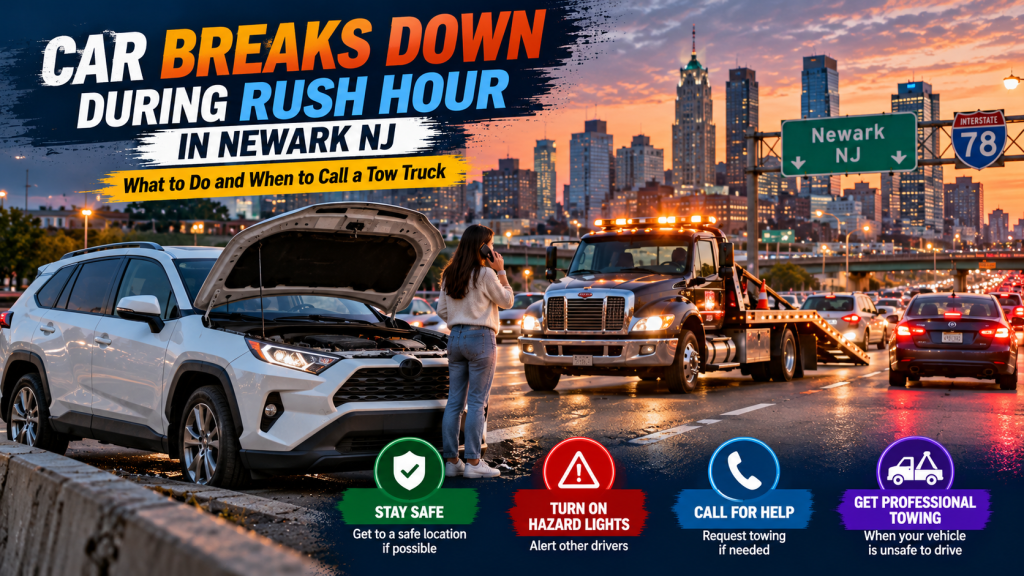
A car breakdown is stressful at any time, but it can become especially challenging during rush hour. Heavy traffic, impatient drivers, crowded intersections, and limited space to pull over can make an unexpected vehicle problem difficult to manage.
If your car breaks down during rush hour in Newark NJ, knowing how to respond can help you protect yourself, avoid unnecessary risks, and arrange the right assistance. Whether you are commuting to work, heading home, or traveling through busy roads in Newark and Essex County, safety should always come first.
We Care Towing & Transport provides towing and vehicle recovery assistance for drivers who need help when their vehicles become disabled. In this guide, we explain what to do if your car stops working in heavy traffic, how to recognize a dangerous situation, and when to call a tow truck.
Why Rush Hour Car Breakdowns Can Be More Difficult
Rush hour often brings slower-moving traffic, frequent stops, and limited opportunities to change lanes. A disabled vehicle can quickly become an obstacle for other road users, especially if it stops in an intersection or a travel lane.
Several factors can make a breakdown more complicated during busy periods:
- Heavy traffic: Other drivers may have limited room to move around your vehicle.
- Limited stopping space: Guardrails, parked vehicles, narrow shoulders, and nearby intersections may restrict your options.
- Reduced visibility: Rain, darkness, or poor weather can make a stopped vehicle harder to see.
- Driver pressure: Traffic noise and impatient motorists can make an already stressful situation feel worse.
- Delayed access: Congestion can affect how quickly roadside assistance reaches your location.
These conditions make it important to stay calm and focus on getting out of immediate danger rather than trying to repair the vehicle in traffic.
7 Common Reasons Cars Break Down During Rush Hour
Understanding the possible causes of a breakdown can help you recognize warning signs before your vehicle becomes disabled.
1. Engine Overheating
Repeated stopping and slow-moving traffic can place different demands on a vehicle’s cooling system. If the system has an existing problem, the engine may overheat.
Watch for a rising temperature gauge, an overheating warning, or steam coming from under the hood.
If your engine overheats, move to a safe location when possible and switch it off. Never open a hot, pressurized radiator cap. If the vehicle cannot maintain a safe temperature, arrange professional assistance instead of continuing to drive.
2. Battery or Starting Problems
A weak battery, charging-system problem, or electrical fault can leave your car unable to restart after stopping.
Warning signs may include slow engine cranking, dim lights, dashboard warnings, or a vehicle that will not start after a short stop.
If the car becomes disabled in traffic and cannot restart safely, avoid repeatedly attempting to start it in a dangerous location. Move to safety if possible and request appropriate assistance.
3. Tire Damage
Potholes, road debris, underinflated tires, and existing tire damage can lead to a flat tire or blowout.
A damaged tire can affect steering and handling, making it unsafe to continue driving. If you suspect a serious tire problem, slow down carefully and stop somewhere safe.
Read our guide on car tire blowouts in Newark, NJ for additional information about tire failure and towing safety.
4. Transmission or Drivetrain Problems
A vehicle may lose the ability to move normally if a transmission or drivetrain component develops a fault.
Possible warning signs include delayed gear engagement, slipping, unusual noises, or a sudden loss of drive.
Do not repeatedly accelerate or force the vehicle to move if it will not respond normally. If you are blocking traffic or the vehicle cannot move safely, request professional assistance.
5. Brake Problems
Brake trouble can become particularly dangerous in stop-and-go traffic, where drivers need to slow down frequently.
Warning signs may include a soft or unusual brake pedal, grinding sounds, a brake warning light, or reduced braking performance.
If the brakes do not feel reliable, do not continue driving. Pull over safely if possible and arrange towing or emergency assistance as appropriate.
You can learn more about warning signs in our article about brake failure towing in Newark, NJ.
6. Fuel-Related Problems
Running out of fuel or experiencing a fuel-system problem can cause a vehicle to lose power or stop running.
Pay attention to the fuel gauge and any engine performance changes. If your car stops in traffic, prioritize safety before considering fuel delivery or other roadside assistance.
If the vehicle cannot be moved to a safe location, towing may be necessary.
7. Electrical or Sensor Problems
Electrical faults or malfunctioning vehicle components can trigger warning lights, affect engine performance, or prevent the vehicle from starting.
A dashboard warning does not always reveal the exact cause. If the car loses power, behaves unpredictably, or displays a serious warning, avoid guessing at the problem while stopped in traffic.
A qualified mechanic can diagnose the underlying fault after the vehicle reaches a safe location.
What to Do If Your Car Breaks Down in Heavy Traffic
If your car stops working during rush hour in Newark, follow these safety steps.
Step 1: Stay Calm and Maintain Control
Keep both hands available to control the steering wheel and avoid sudden movements. If the vehicle is still moving, concentrate on steering it toward a safe place.
Do not make an abrupt lane change simply because the engine has stopped or a warning light has appeared.
Step 2: Move Out of Traffic if Possible
If the vehicle can still be controlled, carefully guide it toward a safe shoulder, parking lot, or other suitable stopping area.
Do not attempt to drive farther if the vehicle has a serious brake, steering, tire, or overheating problem. Reaching a particular destination is never more important than safety.
If your vehicle stops in a live traffic lane and cannot be moved, turn on the hazard lights when appropriate and contact emergency services if the situation presents an immediate danger.
Step 3: Activate Your Hazard Lights
Hazard lights can help alert approaching drivers that your vehicle is disabled.
Use them as appropriate for the conditions, but remember that they do not make a dangerous stopping location safe. Stay aware of surrounding traffic and follow any instructions from emergency personnel.
Step 4: Decide Whether It Is Safe to Exit
Before opening a door, check for approaching traffic, cyclists, and other hazards.
On a busy road, exiting into moving traffic may be more dangerous than remaining inside. If you can safely move away from traffic and reach a protected area, do so. Otherwise, contact emergency services and follow their instructions.
Never stand directly behind or in front of a disabled vehicle in an exposed traffic lane.
Step 5: Avoid Roadside Repairs in Dangerous Locations
Changing a tire, checking the engine, or attempting a repair beside moving traffic can expose you to serious danger.
If your vehicle is in a narrow shoulder, an intersection, or another unsafe location, do not attempt a repair there. Wait for appropriate assistance.
Step 6: Share Your Exact Location
When requesting help, provide your road name, nearest intersection, direction of travel, and a nearby landmark if available.
If you are on a highway, identify the route and the nearest exit or mile marker if you can do so safely. Clear location details can help responders locate your vehicle.
Step 7: Request the Appropriate Assistance
Depending on the problem, you may need roadside assistance, a mechanic, emergency services, or a tow truck.
If the vehicle is unsafe to drive, cannot restart, or is disabled in a dangerous location, professional towing may be the most suitable option.
When Should You Call a Tow Truck During Rush Hour?
Not every vehicle problem requires towing. However, certain situations make it unwise to continue driving.
Consider requesting a tow truck when:
- Your vehicle will not restart and is blocking traffic.
- The engine overheats or steam comes from under the hood.
- A tire is severely damaged or the wheel appears affected.
- You suspect brake or steering problems.
- The vehicle loses drive or cannot move normally.
- Warning lights appear alongside serious performance changes.
- The car makes unusual noises and becomes difficult to control.
- The vehicle is unsafe to drive to a repair facility.
If you are stranded on a busy road, do not wait in a dangerous position while trying to diagnose the vehicle yourself. Focus on safety and communicate the situation clearly when requesting help.
Drivers looking for car towing service in Newark, NJ can visit We Care Towing & Transport to learn more about towing assistance.
What Information Should You Give the Towing Provider?
Providing accurate information can help the towing provider understand your situation and prepare for the vehicle’s condition.
When requesting assistance, be ready to share:
- Your vehicle’s make, model, and approximate year
- Your current location and direction of travel
- Whether the vehicle is in a travel lane, shoulder, or parking area
- The symptoms you noticed before the breakdown
- Whether the engine starts or the vehicle can move
- Any visible tire, wheel, or body damage
- Whether the steering or brakes appear affected
Tell the provider if your vehicle has special towing requirements, such as all-wheel drive or manufacturer-specific transport instructions.
Never put yourself in danger to collect vehicle details or inspect damage. Share only what you can observe safely.
How to Reduce the Risk of a Rush Hour Breakdown
Although some breakdowns happen without warning, routine maintenance and preparation can reduce the likelihood of certain problems.
Keep Up With Scheduled Maintenance
Follow the manufacturer’s recommended service intervals for the engine, cooling system, brakes, tires, battery, and other critical components.
Address recurring problems before they develop into a roadside emergency.
Check Tires and Tire Pressure
Inspect tires for visible damage and uneven wear. Check tire pressure when the tires are cold and use the recommended pressure listed by the vehicle manufacturer.
Watch Dashboard Warnings
Do not ignore persistent temperature, battery, oil-pressure, brake, or other serious warning lights. Consult your owner’s manual and arrange professional inspection when necessary.
Maintain Your Battery
Have the battery and charging system checked if you notice slow starting, dim lights, or recurring electrical problems.
Keep Fuel Levels in Mind
During busy commutes, leave enough fuel for unexpected traffic delays. Do not depend on reaching a fuel station at the last moment.
Carry Essential Emergency Supplies
Depending on your needs and vehicle, consider keeping a charged phone, a flashlight, reflective equipment, and a basic emergency kit in the car.
Supplies can help you communicate and remain prepared, but they do not replace safe positioning or professional assistance.
Plan Your Journey
Allow extra time for busy periods and check traffic conditions before leaving. If your vehicle has been showing signs of a mechanical problem, have it inspected before undertaking a demanding commute.
Why Professional Towing Can Help
When a vehicle becomes disabled in heavy traffic, attempting to drive it to a repair shop may increase the risk of additional damage or create further safety concerns.
Professional towing can transport an unsafe or non-running vehicle to a suitable repair facility. The appropriate towing method depends on the vehicle’s condition, drivetrain, and manufacturer recommendations.
For drivers in Newark, choosing the right assistance depends on the breakdown location and the symptoms involved. A clear description of the problem helps the towing provider understand what equipment may be needed.
We Care Towing & Transport provides towing and vehicle recovery assistance in Newark, NJ, and surrounding service areas. Visit the We Care Towing & Transport website to learn more about available services.
For highway-related breakdown information, you can also consult the New Jersey Department of Transportation’s Safety Service Patrol information.
Frequently Asked Questions
What should I do if my car stops in the middle of traffic?
Turn on your hazard lights when appropriate and try to move to a safe location only if the vehicle can be controlled safely. If the vehicle remains in a live traffic lane and creates a hazard, contact emergency services. Do not attempt roadside repairs in moving traffic.
Should I stay inside my car after a breakdown?
It depends on your location and the surrounding hazards. Exiting into traffic may be dangerous, but remaining in a vehicle in a live lane can also be hazardous. If you can safely reach a protected area, do so. Otherwise, contact emergency services and follow their instructions.
Can I drive my car to a repair shop if it starts again?
A vehicle restarting does not necessarily mean it is safe to drive. If you suspect brake, steering, tire, overheating, or serious drivetrain problems, avoid driving and seek professional advice or towing.
When is towing better than roadside assistance?
Towing is often appropriate when a vehicle cannot move safely, has serious mechanical damage, or should not be driven to a repair shop. Minor issues may be resolved through roadside assistance if the vehicle and location are safe.
Does We Care Towing & Transport help with breakdowns in Newark, NJ?
We Care Towing & Transport provides towing and vehicle recovery assistance in Newark, NJ, and surrounding service areas. Share your vehicle’s condition and location when requesting assistance so the appropriate transport needs can be discussed.
Need Towing Assistance in Newark, NJ?
A rush hour breakdown can be stressful, but taking a calm and safety-focused approach can help you avoid unnecessary risks. Move out of traffic only when it is safe, use your hazard lights appropriately, and avoid attempting repairs in dangerous roadside conditions.
If your vehicle becomes disabled and is unsafe to drive, We Care Towing & Transport provides towing and vehicle recovery assistance in Newark, New Jersey, and surrounding areas.
Visit We Care Towing & Transport to learn more about our services and available towing assistance.
Stay alert, maintain your vehicle, and put roadside safety first.